




2015-09-07
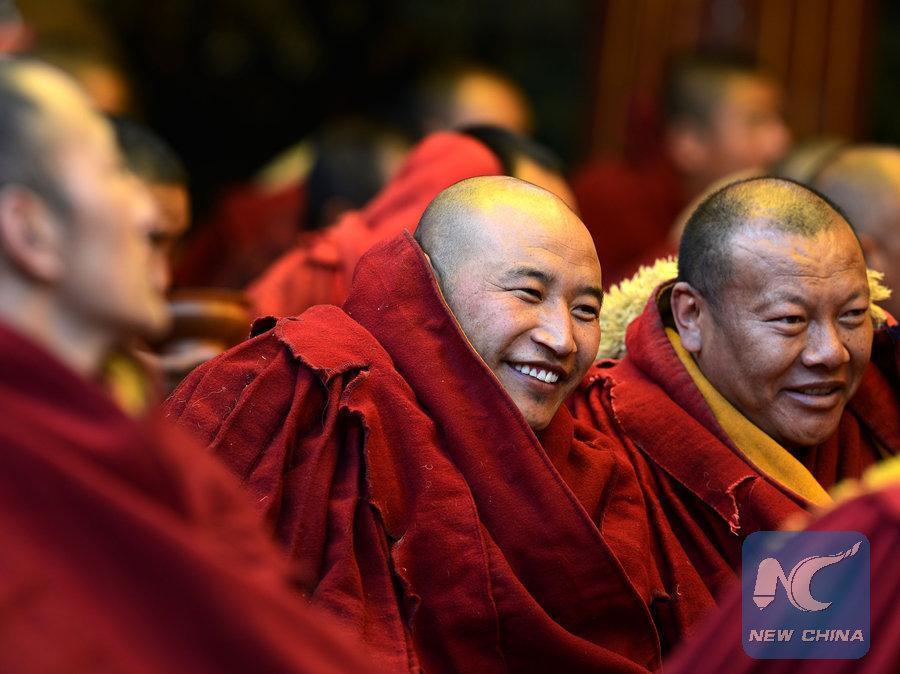
Monks prepare to attend the exam for Gexe Lharampa, the highest academic degree in Tibetan Buddhism studies, at the Jokhang Monastery in Lhasa, capital of southwest China's Tibet Autonomous Region, April 5, 2015.(Xinhua/Chogo)
BEIJING, Sept. 6 (Xinhua) -- China on Sunday issued a white paper on Tibet, reaffirming the current regional ethnic autonomous policy ahead of the 50th anniversary of the foundation of Tibet Autonomous Region. Here is a summary of the key facts and figures:
-- Currently, Tibet has 34,264 deputies to the people's congresses at all levels.
-- From 2012 to January 2013, 94 percent of the constituency of Tibet Autonomous Region participated in direct elections at the county and township levels.
-- From 1952 to 2014, China's central government provided Tibet with financial subsidies totaling 648.08 billion yuan. The amount accounted for 92.8 percent of Tibet's public financial expenditure.
-- Tibet's local GDP soared from 327 million yuan in 1965 to 92.08 billion yuan (14.5 bln U.S. dollars) in 2014, a 281-fold increase.
-- In 2014 the per capita disposable income of urban residents reached 22,016 yuan, a 38-fold increase, or an average annual increase of 10.7 percent compared with 565 yuan in 1978; and that of farmers and herdsmen was 7,359 yuan, representing an average annual increase of 10.9 percent.
-- Tibet took the lead in 2006 in initiating low-income housing projects for local farmers and herdsmen. By the end of 2013, the Region had appropriated 27.8 billion yuan and finished building 460,300 low-income houses.
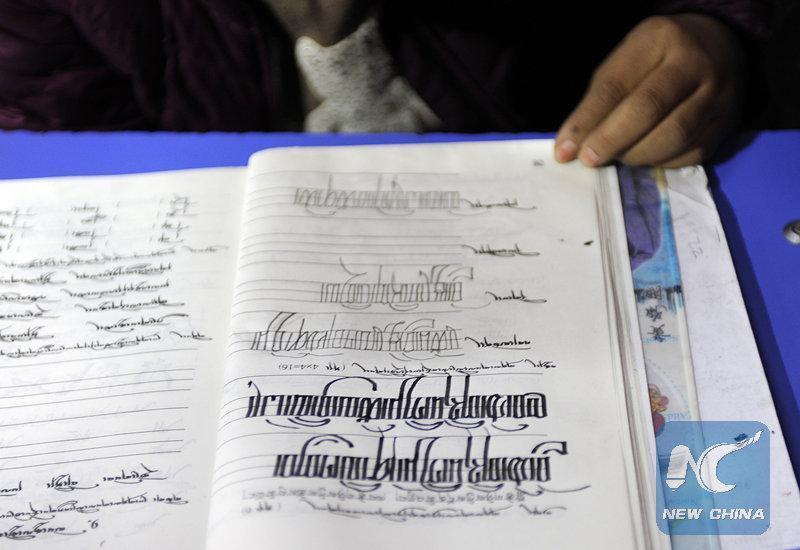
A student of Dhungker Language School demonstrates a piece of Tibetan handwriting exercise in Lhasa, capital of southwest China's Tibet Autonomous Region, Nov. 22, 2012.(Xinhua/Chogo)
-- Bilingual teaching in Tibetan and Chinese is carried out in all schools in Tibet to inherit the Tibetan language in the course of learning.
-- There are now 30,642 bilingual teachers in kindergartens, primary and middle schools, and 5,800 teachers of Tibetan language in primary and middle schools. Tibet Autonomous Region has compiled 821 textbook titles for 13 courses, 410 reference books, 56 syllabuses and curriculum standards, and 73 supplementary books.
-- Tibetan opera and Gesar have been chosen as Masterpieces of UNESCO Intangible Heritage of Humanity, and 89 are on the state level intangible heritage list.
-- Currently, there are 1,787 sites for different religious activities in Tibet, and more than 46,000 resident monks and nuns.
-- Tibet now has 358 Living Buddhas, more than 60 of whom have been confirmed through historical conventions and traditional religious rituals.
-- Tibet has 47 nature reserves, which cover 412,200 sq km, or 34.35 percent of the total land area of the entire Region. Numbers of Tibetan antelopes have grown from 50,000 to 70,000 in 1995 to more than 200,000, and black-necked cranes from 1,000 to 3,000 in 1995 to 7,000.
Titled "Successful Practice of Regional Ethnic Autonomy in Tibet," the white paper said since the democratic reform was carried out in 1959 and regional ethnic autonomy came into practice in 1965, Tibet has established the new socialist system and achieved historic leaps and bounds in its economic and social development.
Practice has fully demonstrated that regional ethnic autonomy is a requirement for Tibet's development and progress, and conforms to the fundamental interests of all ethnic groups in Tibet.
Tibet has taken a road that unites it with all China's ethnic groups and struggles to develop equally, achieve prosperity, and make progress with them, it added.
As part of the Chinese nation, the Tibetan people fulfill the right to participate equally in the management of state affairs; they are thus managers of local social affairs and masters of their own destiny, creating and sharing the material and spiritual wealth of Tibet.
"Tibet is now in its golden age," the paper said.
Copyright © Xizang Daily & China Xizang News All rights reserved
Reproduction in whole or in part without permissions prohibited
Index Code: 藏 ICP 备 05000021 号
Producer: Xizang Daily International Communication Center