





By Liu Fang, Zhu Nan Source:China Tibet News 2019-06-10
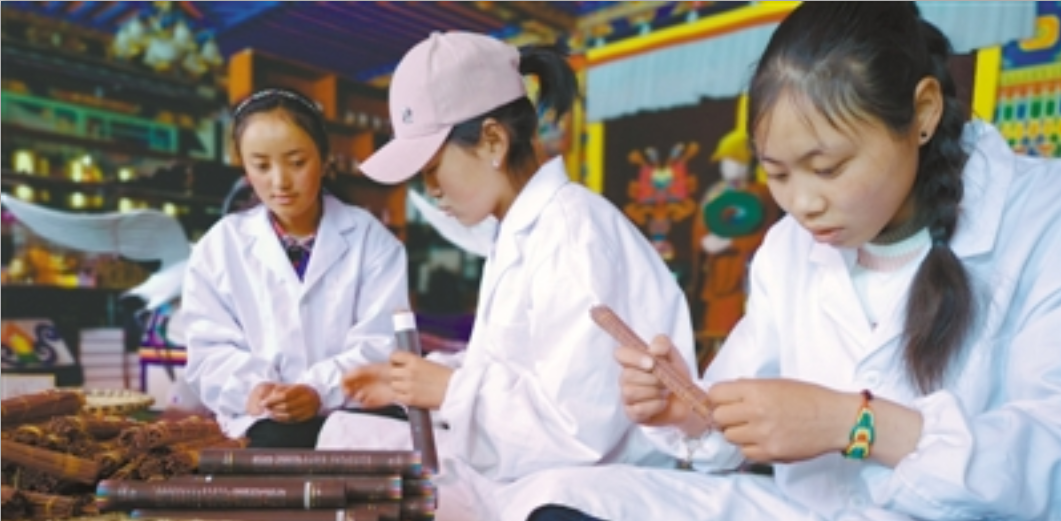
Photo shows workers wrapping local featured products. [China Tibet News/Sun Kaiyuan, Chen Lin]
Bodhi tree is originally a tropical plant. According to the legend, Sakyamuni, the founder of Buddhism, has sit quietly, meditated in a lotus position under a bodhi tree then being enlightened. Therefore, there are profound historical origins between bodhi trees and Tibetan Buddhism. Thangka, known as the Tibetan "encyclopedia", is a unique painting art form in Tibetan culture, and regarded as the treasure of Chinese national painting art as well as a precious intangible cultural heritage in Chinese nation's folk art.
Leaf painting has a long history, but lacks innovation. Pupu, chairman of Zang Sheng Ge Ethnic Handicraft Products Co., Ltd., says that with the rapid development of tourism culture industry in Tibet, various kinds of tourism commodities emerge in one after another. The company combines bodhi leaves with Thangka art to make unique "Bodhi Leaf Thangka", so as to stand out of its kind.
Pupu introduces that at first, one piece of Bodhi Leaf Thangka takes nearly 3 months of importing leaf from Nepal, processing, painting, sending out to mount in Guang Zhou and carrying back to sell in Tibet, the process is extremely complex. After numerous attempts, they can finally make the exquisite "Bodhi Leaf Thangka".
Currently, Pupu has explored a more scientific, efficient and technological way, and shortened the production time, which improves market competitiveness of the Thangka. Under the model of "company + cooperative + craftsmen + farmer", she gathers craftsmen together, carries out trainings and organizes them to make handicraft products during farming slack season, which not only solves the employment problem of 88 registered poor households, but also leads many craftsmen to increase their income and get rich.
In recent years, based on protecting and developing cultural resources, Tibet has integrated fashion elements into traditional culture, making the cultural industry thriving. By the end of 2018, Tibet has more than 6,000 cultural enterprises, over 50,000 employees and 234 cultural industry demonstration parks (bases) in the whole region. The region's output value of cultural industry has increased from 2.424 billion yuan RMB in 2013 to 4.6 billion yuan RMB in 2018, maintaining an average annual growth rate exceeding 15% in five consecutive years. Cultural industry's contribution to Tibet's economic growth is becoming more.
Nowadays, on the basis of the plan on developing characteristic cultural industry, Tibet has continuously adopted multiple measures such as art skill upgrading, financial support and policy guidance, to realize the added value of cultural industries accounting for 5% of Tibet's annual GDP in the 13th Five-Year period, as well as culture industry becoming one of the pillar industries to drive Tibet's economic development.
Copyright © Xizang Daily & China Xizang News All rights reserved
Reproduction in whole or in part without permissions prohibited
Index Code: 藏 ICP 备 05000021 号
Producer: Xizang Daily International Communication Center