





By Liu Fang, Zhi Xinghua Source:China Tibet News 2019-06-21
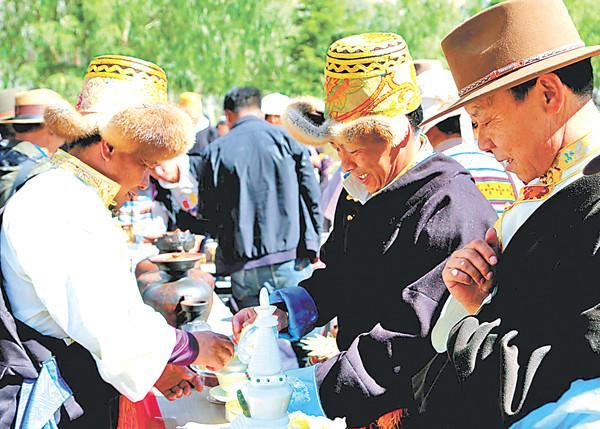
Recently, Qonggyai County has held activities of 2019 "Cultural and Natural Heritage Day" and intangible cultural heritage exhibition. Excellent ethnic costumes, traditional crafts, dance, music, wine culture and so on have been elected from 12 intangible cultural heritage projects in the county for the on-site exhibition and performance. Photo shows the exhibition site. [China Tibet News/Tsewang, Lhundrup Tsering]
On June 8, a performance has been held at the Tibetan Opera Performing Arts Center of Lhasa City to mark the 10th anniversary of the inclusion of Tibetan opera in the UN intangible cultural heritage list.
In order to better publicize and display the achievements of Tibetan opera art in the new era, the achievements report performance has been performed three times in succession at the Tibetan Opera Performing Arts Center by taking advantage of the 2019 "Cultural and Natural Heritage Day".
Tibetan opera has a long history, numerous schools as well as strong ethnic and regional characteristics. It is a comprehensive art that integrates singing, chanting, dancing, performance, rap, technique and literature. It is praised as the "encyclopedia" of the Tibetan people, the "living fossil" of local operas in China, and the cultural treasure of the Chinese nation.
Over the past ten years, with the implementation of the eight traditional Tibetan operas staged projects and the simultaneous progress of the construction of the multi-media resource library, the Tibetan Opera Troupe of Tibet Autonomous Region has been investing manpower and material resources in compiling and creating Tibetan opera plays with realistic themes in the new era.
At present, covering an area of 1,080 square meters, the China Tibetan Opera Museum has entered the final construction stage. After completion, it is of great significance to the publicity, promotion, protection, inheritance and development of Tibetan opera.
After the Tibetan opera, the Tibetan Epic Gesar and the Tibetan medicinal bathing have been included in the UN representative list of the intangible cultural heritage of mankind.
Compared with the old Tibet, Gesar artists have received more respect and attention in the new era. Barga, representative inheritor of state-level intangible cultural heritage and a Gesar rapper of Nagqu City, says, "as a rapper, while refining the art, I also need to cultivate a better moral character."
"The pace of creative transformation and innovative development of Tibet's excellent traditional culture is accelerating," says Gangqing, deputy party secretary and director of the Culture Department of Tibet Autonomous Region.
Tashi Tsering, a state-level intangible cultural heritage inheritor of Tibetan Garl Singing and Dancing, is also an autonomous regional level intangible cultural heritage inheritor of Lhasa Dulxie (Tibetan song with tap dance) and Lhasa Dranien (Tibetan guitar) playing and dancing.
Being one of the 20 Garl singing and dancing team members of the Potala Palace in the old Tibet, he becomes a university teacher, specializing in traditional Tibetan culture and art education and research work in the new era.
In order to protect and develop the traditional culture and art, Tashi Tsering says that he has never really rested since being retired at the age of 60. He says, "I have started to learn Garl art at the age of 10, and it has been 70 years since I have become attached to it. Although getting old, I always feel time is not enough.Fro the state to the region, more and more attention has been paid to the protection of Tibetan culture. I hope that in my limited life, I will leave the Tibetan artistic treasures I have learned to the posterity."
In Tibet, more than 35% of the representative inheritors of state-level intangible cultural heritage are over 70 years old.
Data show that Tibet has 84 designated teaching and learning bases for intangible cultural heritage programs, and 165 teaching and learning sites at all levels. Besides, there are 89 state-level representative projects and 96 inheritors, as well as 460 autonomous regional level representative projects and 350 inheritors.
Tibet has basically established a state, autonomous regional, prefecture (city), county (district) four-level intangible cultural heritage protection list system, and formed a number of protection work mechanisms. Each year, Tibet sets up a special fund of 12 million yuan RMB for the protection of intangible cultural heritages. The annual subsidy for inheritors at the autonomous region level is increased to 10,000 yuan RMB per person, ranking among the highest in China.
Copyright © Xizang Daily & China Xizang News All rights reserved
Reproduction in whole or in part without permissions prohibited
Index Code: 藏 ICP 备 05000021 号
Producer: Xizang Daily International Communication Center