





Source:xzxw.com 2025-12-11
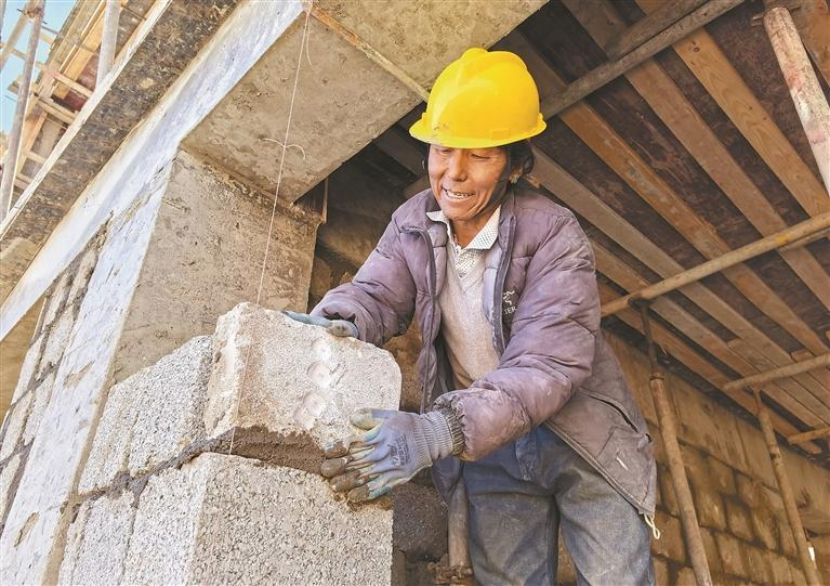
Photo shows a worker beginning construction on the main structure of the final rebuilt house in Migmar Natural Village, laying bricks for its walls.
Is it worth building a special cableway to transport construction materials for just three households being rebuilt deep in the mountains?
In Lhatse County, Xigaze, facing the "major test" of post-earthquake recovery and reconstruction, Party committees and governments at all levels in the local area have given an unequivocal answer through their actions —
Yes, it is! Because the people come first, no cost is spared.
Yes, it is! Because life comes first, no effort is spared.
In the cold late autumn wind, in a valley of Namkar Village, Phuntsokling Town, as machinery clattered, steel cables pulled several hanging buckets upward, swaying steadily toward the three mountain households deep in the clouds.
Local people have long called this valley "Namkar Valley". The three households here reside in a place officially named "Migmar Natural Village".
To reach Migmar Natural Village, one must depart from the administrative village headquarters,heading west along a cement road, then turn onto a dirt road for nearly 10 kilometers, passing 20 scattered households undergoing reconstruction along the way.Despite the short distance, the rugged, bumpy road takes 3 hours to walk one way.
Zhang Chengsheng, secretary of the Phuntsokling Town Party Committee, explained that Namkar Valley has a unique climate. During the rainy season, it is often cloudy at the foot of the mountains while downpours rage uphill; when it rains below, hail storms hit the higher ground. With above-average rainfall this year, the newly widened dirt road was washed away overnight by heavy rain. The county dispatched special personnel to monitor the site daily, investing over 300,000 yuan in road repairs, maintenance and other related work.
While the road was reopened urgently, construction materials for 17 households were delivered one after another, allowing the project to proceed. However, the three households in Migmar Natural Village alone remained a tough nut to crack.
With only three households, why not relocate them?
Zhang Chengsheng said that considering future development, during the targeted poverty alleviation campaign, county and township authorities urged them to relocate, but the effort fell through. Amid this post-disaster reconstruction, cadres have persuaded them repeatedly, yet it still didn’t work out.
“Our family’s pasture is close by, and we have quite a few cattle and sheep — it would be hard to take care of them if we moved,” said Sonam, one of the reconstruction households, voicing his true feelings. Beyond the livestock, there is also a deep attachment tothe land that has sustained their ancestors for generations. What touched them most was the government’s final decision, “since the masses are unwilling to relocate, we will build the houses no matter how difficult it is!”
At the start of the reconstruction, loaders hauled construction materials upfront while excavators pushed ahead from behind but it didn’t work. They also tried transporting by pack animals and carrying them manually, only to find the labor costs too high and efficiency too low. “We even considered airlifting materials by helicopter, but ultimately had to abandon the idea due to restrictive conditions,” said Zhang Chengsheng.
As time passed, everyone was at a loss. After repeated discussions, an idea suddenly emerged: draw on the experience of transporting power tower materials uphill and adopt cableway transportation.
Soon, after on-site surveys and thorough demonstrations by a professional cableway construction team, this 3-kilometer-long"special transportation line" was successfully erected.
Watching the cableway in operation, Latok, the person in charge of the construction team, sighed with relief, "from 8am to 8pm, we can transport about 18 cubic meters of materials every day. It's slow, but at least we can get the materials up there."
Among the three reconstruction households, Lhakyi’s family lives at the highest point, with an elevation of close to 4,900 meters.
After the earthquake, mobile phone signals were lost. The family of 8 feared most that "the mountains are high and the road is far, so the government might forget about us." Their worries vanished when Dondrub Tsering, secretary of the village Party branch, arrived dusty on his motorcycle.
"From the day we moved into tents after the earthquake, we have never been cold or hungry," Lhakyi said emotionally, sitting by the stove in her new house. "The Party and the government have spent so much money to build us a new home and even built a special cableway — I am extremely grateful..."
Leaving the benefits to the people and shouldering the difficulties themselves. LodenKelsang, member of the Standing Committee of the Lazi County Party Committee and director of the United Front Work Department, is the leading cadre in charge of Pengcuolin Town and has remained at the frontline to this day. Before reconstruction began, aftershocks occurred frequently. Putting aside his physical discomfort,he conducted inspections at remote sites on numerous occasions,preventing secondary injuries.
Zhang Chengsheng,the Partysecretary of the town, was tasked with following up on construction progress and assisting in resolving problems.After months of working outdoors, he was tanned and his shoes and trousers were covered in mud. He laughed and said,"Many villagers took us for construction workers."
Nyima Lhundrup, a post-2000s staff member from the township, lived and ate beside the construction site. With nighttime temperatures dropping to below zero Celsius, he had to go to bed quickly after dinner to keep warm.
During the critical phase of reconstruction, Party members and cadres at all levels formed volunteer service teams and donated labor at the frontline...
By the end of October, all 113 reconstructed houses in Namkar Village were completed and handed over. People have moved into their new homes one after another, embarking on a new life.
Looking back now, is this cableway merely transporting bricks, tiles and cement for house construction? Obviously not. It carries the determination to "not leave a single affected household behind on the road to reconstruction" and witnesses the most concrete echo of the "people-centered development thought" on the Qinghai-XizangPlateau.
No matter how high the mountains or how far the roads, not a single household will be left behind, and no one will be abandoned.
Reporter: Yang Ziyan, Ma Xiaoyan, Tashi Dondrup, Tenzin Gawa
Translator: Dan Zhen, Zhi Xinghua
Review: Hu Rongguo, Li Chengye
Copyright © Xizang Daily & China Xizang News All rights reserved
Reproduction in whole or in part without permissions prohibited
Index Code: 藏 ICP 备 05000021 号
Producer: Xizang Daily International Communication Center