





Source:xzxw.com 2026-03-06
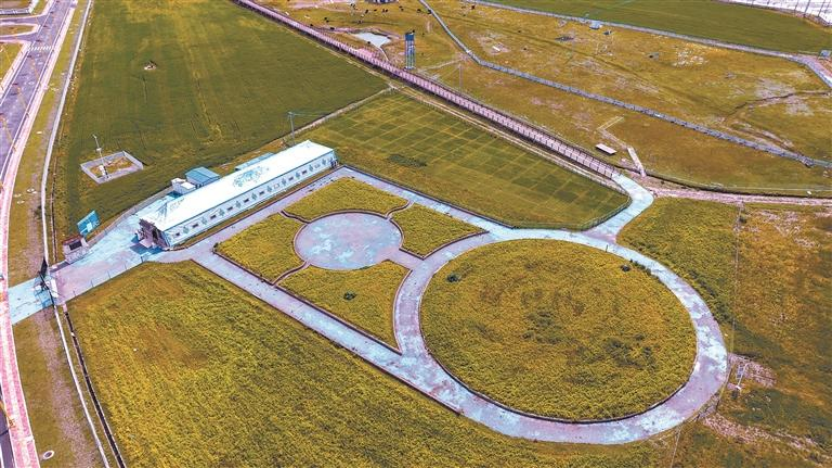
The prataculture technology backyardand its experimental fields. Photo by Xu Yuyao, People's Daily
Nagqu City of Xizang Autonomous Region in China, located in the northern Xizanggrassland, sits at an average altitude of over 4,500 meters. Due to the high altitude, the grassland ecosystem is fragile, and most of the grass here only grows to the length of a finger.
On the outskirts of Nagqu City, the Xizang Nagqu Prataculture Technology Backyard was established in 2022, relying on the Nagqu City Agriculture and Animal Husbandry (Prataculture) Science and Technology Research and Promotion Center. With technical support from the Institute of Environment and Sustainable Development in Agriculture, Chinese Academy of Agricultural Sciences, it is dedicated to exploring better ways to protect this alpine steppe.
Restoring pastures: from "cattle refuse to graze" to "yaks stroll in".
At the technology backyard, technician Awang Pema is inspecting the growth of various plants in the experimental field. Beside her, the field is divided into 60 cm square plots, with dozens of such plots planted with different vegetation. Researchers control variables like vegetation type and planting density between plots and have installed various equipment to monitor soil moisture and observe the impact of different growing environments on plants.
"We have conducted numerous comparative experiments and studies, all aimed at better understanding the growth characteristics of vegetation in Nagqu," Awang Pema explained.
In Amdo County, NagquCity, amidst the wilderness at an altitude exceeding 4,700 meters, He Shicheng, an animal husbandry specialist from the Nagqu City Agriculture and Animal Husbandry (Prataculture) Science and Technology Research and Promotion Center, leads researchers in fieldwork. "Through field investigations, we have collected and stored 50 species of native wild forage seeds, screened 16 dominant wild forage varieties, and cultivated 8 domesticated species with high potential and strong adaptability in experimental fields," He Shicheng introduced.
A few years ago, in Gaqing Village, Serni District, Nagqu City, the land was barren, with sparse grass and few cattle or sheep seen. "We focused on the barren land and severely degraded grassland in Gaqing Village to conduct demonstration studies on rodent control isolation techniques, research on water-saving self-pressure irrigation technology for enhancing yield and efficiency in regional artificial grasslands, and demonstration and promotion of the 'winter forage reserved for summer use' facilityrecyclingtechnology," He Shicheng stated.
Promoting technology: conducting research and teaching farmers and herders.
Effectively serving the needs of the people and strengthening the promotion of prataculture technology are crucial tasks for the technology backyard. "The promotion of new prataculture technologies holds not only production value but also ecological value," said Gandru Tsabu, a supervisor at the technology backyard and Associate Researcher at the Institute of Environment and Sustainable Development in Agriculture, CAAS. "Unscientific animal husbandry practices cause tremendous damage to pastures. Therefore, we must not only conduct scientific research but also impart these research findings to farmers and herders, amplifying their practical impact."
Scientific rotational grazing is a method Gandru Tsabu is dedicated to promoting.
In summer, yaks are seen everywhere on the grassland, but the frequency of grazing a particular area involves significant consideration. "Our research found that compared to other grasslands, alpine grasslands recover more slowly, so the rotational grazing cycle should be extended," Gandru Tsabu explained.
Through repeated experiments, researchers identified a relatively balanced approach: a "long-cycle, low-frequency" rotational grazing method involving 10 days of grazing during the warm season followed by 20 days of rest. This method balances ecological protection with the needs of local production needs, playing a vital role in improving alpine grassland productivity, enhancing species diversity, and increasing grassland utilization rates.
Cultivating talent: better transforming the icy and snowy land of the Northern XizangPlateau into a gold and silver mountain.
Conducting continuous scientific research in Nagqu is no easy feat. The plateau climate and harsh conditions pose significant challenges.
"Engaging in prataculture research here requires exceptional perseverance," Cao Zuonan remarked. "We have a group of graduate students working long-term in Xizang, which not only hones their skills but also deepens their commitment to working on the plateau."
Ma Yandan is a second-year doctoral student at the Chinese Academy of Agricultural Sciences. Over the past three years, she has come to the technology backyard annually for research.
"Although conditions are tough, the unique natural environment offers more opportunities for discovery," Ma Yandan said, unable to hide her excitement when discussing her research field. "We are exploring factors influencing changes in grassland productivity. There's vast scope for experimentation and exploration here. What could be more appealing than new discoveries?"
"The technology backyard will continue its focus on alpine grassland ecology research, conducting studies aimed at the high-quality development of grass and animal husbandry in alpine regions," Gandru Tsabu stated. "We hope to cultivate more talent to serve local development through technology, better transforming the icy and snowy landscape of the northern Tibetan plateau into a valuable asset for the people."
Reporter: Xu Yuyao
Translator: Dan Zhen, Liu Fang
Review: Phurbu Tsering, Drakpa Wangchen
Copyright © Xizang Daily & China Xizang News All rights reserved
Reproduction in whole or in part without permissions prohibited
Index Code: 藏 ICP 备 05000021 号
Producer: Xizang Daily International Communication Center