





Source:xzxw.com 2026-03-18
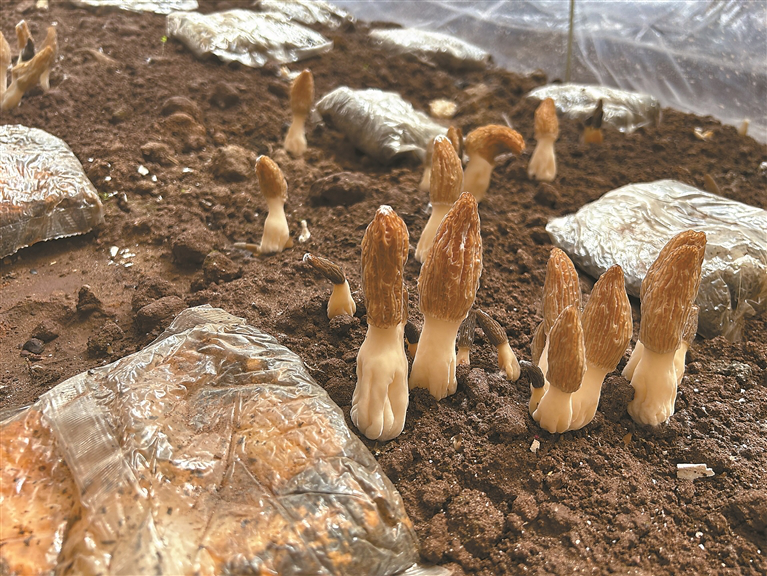
Photo shows morel mushrooms emerging from the soil. [Photo/Gonchuk Chogtso]
On the Qamdo land with an average altitude of 3,500 meters, as spring arrives, plump and brown-black morel mushrooms are emerging from the soil. Currently, 90666.67 ㎡ of morel cultivation bases in places such as Kargang Town and Yendum Town in Chagyab County, Guro Town in Karub District, and Wayue Village in Karub Town are entering the critical fruiting and peak harvest period.
In the early morning, mist lingers inside the 76 greenhouses of the Kargang cultivation base. Base manager Ding Tianwen carefully harvests the dew-kissed mural mushrooms, slicing their stems and letting them fall gently into bamboo baskets.
"Our town boasts the largest morel mushrooms cultivation base in Qamdo. This year, we've planted nearly 66666.67 ㎡ this year. Once all the mushrooms have sprouted, we can harvest over 500 jin (1 kg =2 jin) of fresh morel mushrooms every day. Through the 'cooperative + farmers' model, 68 local households earn an extra 5,000 yuan each on average," Ding said with a beaming face.
These small morel mushrooms reflect more than upgraded agricultural thinking, showcasing the new possibilities brought by technology. In Qamdo, winters are long and cold, and the region was once regarded as an "off-season" for agricultural production. Today, with technical support from the Qamdo Institute of Agricultural Sciences, idle winter greenhouses have become productive "treasure troves."
In Yendum Town, 5333.33 ㎡ of morel mushroom greenhouses are thriving. "The technicians from the institute guided us in using the 'D6' strain, ideal for the plateau climate with a survival rate of 90%," said Sonam Bartso, Party branch secretary of Dangzuo Village. This resilient strain is perfectly adapted to Qhamdo's high-altitude conditions and large temperature swings.
Technological innovation drives the industry. As the city's hub of technical expertise, high-quality strains such as "Qimei" and "D6" are cultivated at the experimental fields of the Institute. "Localizing production from seed to cultivation halves costs compared with buying externally," said Niu Jiping, Institute director, crouching in the morel mushroom field. "Our base produces over 200,000 bags of spawn and nutrient packs annually, supplying local farmers and neighboring counties, which provides solid technical support for industrial development."
At the demonstration base in Jialin Village, Guro Town, deputy director Wei Zhilei of the institute shows villagers how to control temperature and humidity. "Morel mushrooms need precise growth conditions: 8–15℃ and 70% humidity," he explained, pointing to the monitor. Thanks to the localized and improved cultivation technology, the high-altitude morel mushrooms achieve a premium rate exceeding 80%. Greenhouse manager Fu Wenbao remarked, "these tools give us much more confidence in cultivation."
Today, Qamdo's morel mushroom industry encompasses a full chain: research, base, farmers, and processing. In the processing workshop of Xuanhong Industrial Co., Ltd., morel mushrooms are sorted, cleaned, dried and packaged into "Snowland Delicacy" gift boxes. "Fresh morel mushrooms are transported via cold chain to major cities like Beijing, Shanghai, Guangzhou, and Shenzhen, while dried mushrooms and mushroom soup packs are sold both online and offline. The added value of our products has tripled," said Wu Junying, the person in charge of the company. From selling raw materials to products, from field to table, Qamdo's morel mushrooms are transforming into high-value-added commodities.
Niu Jiping added that this year, the 90666.67 ㎡ base is expected to yield a total output of 75,000 jin, with a total value exceeding 6 million yuan. Next, the institute will build a gene pool of morel strains and develop even higher-quality varieties to strengthen this distinctive industry.
From laboratory to field, the rise of the Qamdo's morel mushroom industry also relies on innovative models. In 2025, the institute staff trained 3,000 farmers and herders (cumulative participants) across seven counties and districts—including Karub, Chagyab, and Pashod—bringing cultivation technology directly to the fields. This "research + base + farmers" model allows local farmers and herders to become true participants and beneficiaries of the industry, keeping development benefits in rural areas.
Each tiny morel mushroom not only solves the challenge of increasing agricultural productivity in the highland winter but also paves a replicable, scalable, and community-beneficial path to prosperity, injecting continuous new momentum into rural revitalization in eastern Xizang.
Reporter: Gonchuk Chogtso, Liang Xia, Niu Jiping
Translator: Yang Xiaofeng, Zhi Xinghua
Review: Hu Rongguo, Drakpa Wangchen
Copyright © Xizang Daily & China Xizang News All rights reserved
Reproduction in whole or in part without permissions prohibited
Index Code: 藏 ICP 备 05000021 号
Producer: Xizang Daily International Communication Center