





Source:xzxw.com 2026-04-07
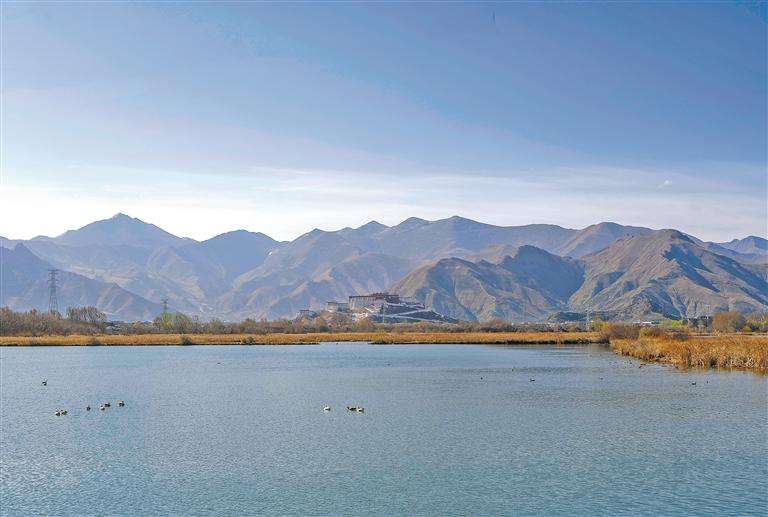
Photo shows a view of the Lhalu Wetland, known as the "Lungs of Lhasa." [Photo/Tenzin Chosphel]
Xizang is rich in wetland resources with unique types and outstanding ecological value. Protecting these wetlands has long been a priority for Xizang, an ongoing challenge requiring sustained effort.
Coordinated protection, restoration, and monitoring of highland wetlands
Highland wetlands are ecologically fragile and challenging to restore. Their survival hinges on scientific protection and restoration. Xizang has consistently pursued coordinated efforts in wetland conservation, reviving these vital ecosystems.
The Lhalu Wetland serves as a model of wetland protection and restoration. Once degraded, it has now returned to a healthy state.
"I am a native Lhasa resident. I remember this area used to be filled with grazing cattle and sheep, with houses scattered around," said a resident. Thirty years ago, due to its proximity to residential areas and waste sites, desertification took a toll. Untreated urban sewage was discharged into the wetland, shrinking its area by 20% compared to the 1970s.
In 1995, a wetland protection project was launched with an investment of nearly 900 million yuan (≈US$130 million) across four phases. The initiative addressed key issues like overgrazing, water shortages, and vegetation loss, gradually restoring the wetland.
Today, the Lhalu Wetland National Nature Reserve's ecological restoration has been recognized as a national case study in integrated conservation of mountains, waters, forests, farmlands, lakes, grasslands, and deserts, providing valuable experience for urban wetland restoration across China.
Scientific protection depends on accurate monitoring. In 2023, Xizang established its first urban wetland ecosystem observation station at Lhalu Wetland. Using remote sensing, species tracking, and other multidisciplinary methods, researchers have created a comprehensive ecological database.
Legal and regulatory safeguards for sustainable wetland management
Wetland protection is a long-term commitment, requiring a robust legal framework. Xizang has developed a three-pillar system of laws, regulations, and rules, ensuring that wetland conservation is legally grounded, procedurally sound, and verifiable.
The Wetland Conservation Law of the People's Republic of China, which took effect on June 1, 2022, prompted Xizang to revise and issue local regulations, including the Xizang Autonomous Region Wetland Conservation Regulations and the Wetland Identification and Listing Management Measures (Trial). Together, these create a legal framework aligned with national laws while adapting to local conditions.
The Xizang Autonomous Region Regulations on the Construction of a National Ecological Civilization Highland, implemented in 2021, incorporated wetland protection into the integrated protection and systematic governance of mountains, waters, forests, farmlands, lakes, grasslands, and deserts. The regulations fully implement the forest chief scheme and the responsibility system for protecting rivers, lakes, forests, and grasslands, clarifying the wetland management responsibilities of governments and departments at all levels. Wetland protection performance is linked to official assessments, creating a work pattern where each level takes responsibility.
Mapham Yutso in Purang County, Ngari Prefecture, features lush aquatic plants and meadows, with dozens of yaks grazing leisurely. Represented by the Mapham Yutso Wetland National Nature Reserve, Xizang has gradually established a professional, routine wetland management mechanism, ensuring every wetland has dedicated personnel for protection and management.
Li Hairong, a staff of the Purang Natural Resources and Forestry and Grassland Bureau, explained that since 2012, the reserve has built six management stations and employed 90 professional rangers to carry out patrols, garbage collection, and other tasks. Through technical training and legal outreach, the professional capacity of rangers has been improved, forming a wetland protection pattern of professional management and public co-governance.
Share ecological benefits to achieve harmony between people and nature
The ultimate goal of wetland protection is to safeguard the ecological homeland and benefit local communities, balancing ecological, social, and economic gains, so that communities can share in the dividends of ecological conservation while protecting lucid waters and lush mountains.
In 2016, Xizang launched a pilot program for wetland ecological benefit compensation in three counties—Xainza, Dinggyê, and Nanggarzê. Over three years, more than 48 million yuan (≈US$7 million) was invested in measures like grazing compensation and vegetation restoration, achieving a win-win outcome for both ecological protection and community livelihoods. "I used to rely on grazing for a living, but now I protect the ecology while earning more. Life has improved," said Chodron, a herder from Xainza.
Xizang has consistently integrated ecological and social values, protecting wetlands while also tapping into their potential for sustainable development. The Yani National Wetland Park in Nyingchi City is a prime example.
The Yani Wetland, formed at the confluence of the Yarlung Tsangpo River and the Nyangchu River, is known for its beautiful and unique landscape. Seguola Village, Mainri Town, Bayi District, Nyingchi City, located on the edge of the Yani Wetland, was once an ecologically fragile place. In early spring 2009, Qiao Tsering, Party branch secretary of Seguola Village, decided to plant trees to restore the area.
Planting trees not only stabilized the sand but also brought prosperity to Seguola Village. From planting 1,000–2,000 mu (≈67–133 hectares) of trees per year in the early years to more than 5,000 mu (over 333 hectares) in peak years, the village has planted several hundred thousand trees over more than a decade, achieving remarkable results in afforestation and sand control. As the environment improved, villagers shifted from traditional agriculture to eco-tourism, diversifying their income streams.
From technology-driven restoration to a sound legal systemand the sharing of benefits with local communities, Xizang has pioneered a distinctive path for wetland protection. The region is home to four wetlands of international importance - Mapham Yutso, Mitika, Serling Co, and Zhari Namco - as well as four wetlands of national importance, including Lhalu, Lhato, Pangong Tso Lake, and Lharo. Wetland conservation continues to expand across the region.
Reporter: Ngodrup Tsering
Translator: Yang Xiaofeng, Zhi Xinghua
Review: Hu Rongguo, Drakpa Wangchen
Copyright © Xizang Daily & China Xizang News All rights reserved
Reproduction in whole or in part without permissions prohibited
Index Code: 藏 ICP 备 05000021 号
Producer: Xizang Daily International Communication Center