





Source:xzxw.com 2026-04-27
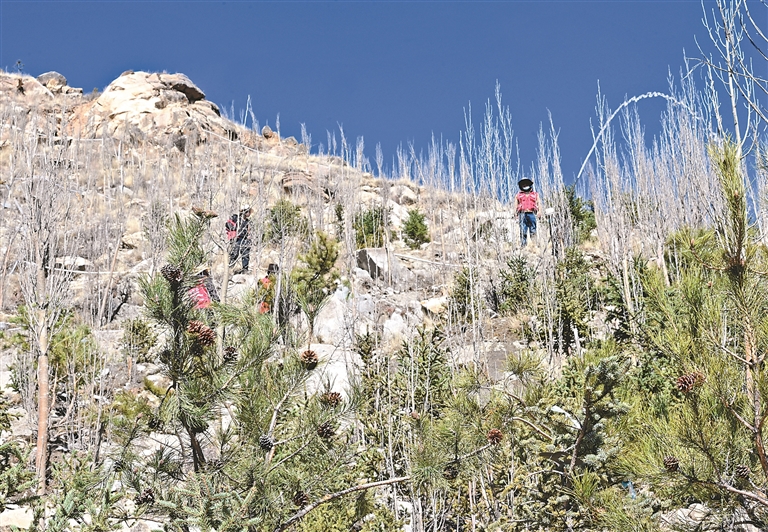
Photo shows that villagers from Weiba Village, Togde Subdistrict, Lhasa, take part in a spring tree-planting activity on the slopes of Phurbuchok Mountain in 2026. [Photo/Losang]
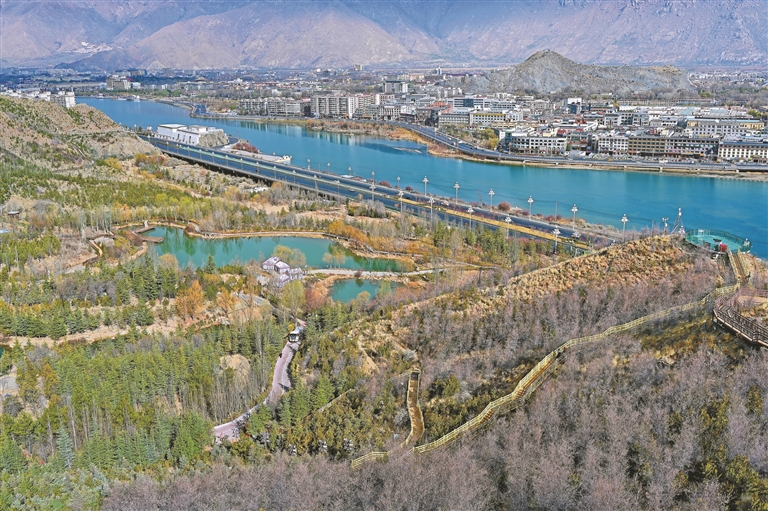
Photo shows a view overlooking the Lhasa Valley and the urban area from Nanshan Park. [Photo/Tang Bin, Pema Tsewang]
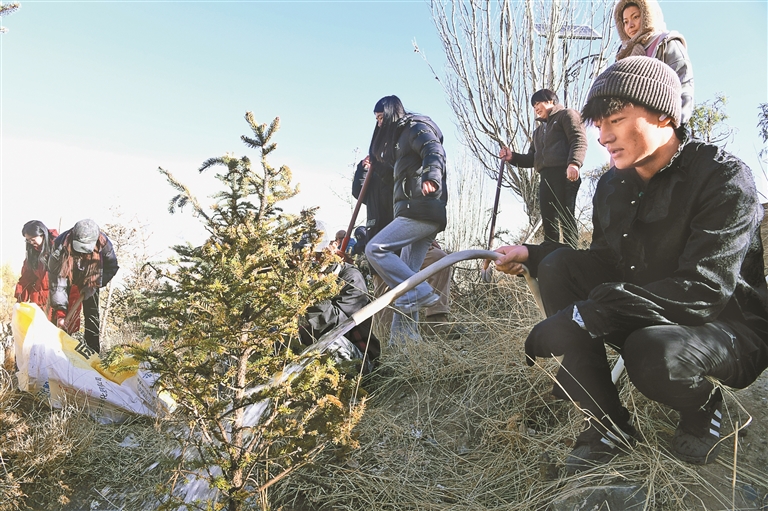
Photo shows that volunteers take part in a tree-planting activity at Nanshan Park. [Photo/Losang, Tang Bin]
In the spring of March 21, 1961, Xizang Daily ran a story headlined "Tree-Planting Campaigns Launched Across Lhasa's Urban Districts." It read: "With their lives improved, the emancipated masses urgently desire a better environment and are eager to build their homeland more beautifully..."
As Xizang Daily marks its 70th anniversary, we traced the journey along the Lhasa River, following clues in those yellowed pages — touching the arc of history from scattered saplings to the North-South Mountain Greening Project, listening to the resolute footsteps behind the leap in forest coverage from 5.1% to 12.54%, and exploring how the philosophy that "lucid waters and lush mountains are invaluable assets" is being put into practice.
Emancipated serfs: the first rows of green
Documents from the Xizang Autonomous Region Archives reveal that in March 1962, the Xizang Committee of the Communist Party of China and the Preparatory Committee of the Xizang Autonomous Region jointly issued a call to action through Xizang Daily. It urged the entire region to fully implement the policy of "those who plant, own; those who own, use," and to mobilize the public to plant trees and green the "Four Sides."
The "Four Sides" referred to ways around villages, houses, roads and water. On this land waiting to be rebuilt, the emancipated people launched a voluntary greening drive that quietly began a green relay spanning more than half a century.
A reader's letter on the front page of Xizang Daily on January 28, 1962, read: "Dear editor, here's some good news: a tree-planting team at Chushur Farm is already in action..."
Tsering Yangzom, 83, once worked at Chushur Farm. She still remembers heading out before dawn with a shovel, farming the land and digging pits for trees from morning till night.
Over time, the planting area expanded from the "Four Sides" to barren floodplains and riverbanks. Tencho, a former community official in Lhasa's northern urban district, recalls: "People came on their own. We could plant two to three thousand trees in a single day."
"Back then it was mostly hard work — we planted wherever there was space." Retired now, Tencho still thinks of those trees — now a lush, full-grown forest.
From easy to difficult: sprinkling the plateau with green
On the high-altitude, oxygen-scarce, and infertile plateau, a tree struggles many times harder to survive than on the plains.
Sonam Wangdu, former deputy director of the regional Forestry and Grassland Administration and technical adviser for the North-South Mountain Greening Project, views 1991 as a turning point. Before that, funds were scattered and seedling survival rates were low. That year, the State Council made the "One River, Two Streams" comprehensive development project — focused on the Yarlung Zangbo, Lhasa and Nyangchu rivers — as a national priority, ending the fragmented funding. Afforestation in Xizang took shape in a coordinated way — led by urban greening, anchored by project-based planting, and extended across rural and urban areas alike.
A planting boom swept the region. In places like Kangsar (Xigaze), Zetang (Lhoka), Gortang (Nyêmo), and Tari (Gyangzê), once-exposed barren flats gradually disappeared beneath stretches of shelterbelt forest.
Techniques also improved — from stem cuttings to rooted seedlings, from spring-only planting to rainy-season and autumn planting, from tall, dense layouts to shorter stems at proper spacing. Afforestation grew more standardized, more science-based.
Today, along the Yarlung Zangbo, continuous shelterbelts anchor the landscape.
But while the valleys turned green, the bare mountains remained.
In spring 2008, Xizang launched its first high-altitude afforestation trial on barren slopes, planting over 3,000 Chinese pine, lacebark pine, and spruce directly into exposed rocks — the first forest created for building a garden city.
Five years later, on April 25, 2013, Xizang Daily dedicated an entire page to an in-depth observation piece: "How Lhasa is Taking Trees Uphill." Could trees truly climb mountains? Where did the difficulty lie? How could it be solved? Could the approach be replicated? The four questions sparked heated debate.
"That tiny layer of green on Lhasa's southern mountain gave us boundless joy and confidence," Sonam Wangdu said.
Adding splendor: green water and mountains in service of a promise
On October 4, 2021, the North-South Mountain Greening Project was officially launched.
Large-scale afforestation on the "Roof of the World" is a global challenge.
To tackle it, Xizang integrated forestry, agricultural, scientific, and other resources, assembled specialist afforestation teams, and introduced an innovative model of "government leadership + business participation + and employment for farmers and herders," enabling more people to share the dividends of greening.
So far, the project has completed over 1.3 million mu (≈86,667 hectares) of afforestation, with an overall survival rate exceeding 85 percent. A supporting infrastructure system that ensures water reaches the trees, electricity reaches the water supply, and roads reach the planting sites is essentially in place, and the phase target of "greening mountains and valleys in five years" has been largely achieved.
According to official figures, the project has cumulatively mobilized some 10 million person-times of labor and generated 3.3 billion yuan in income for local communities.
Even more heartening, the restoration of ecological chains is gradually reviving the plateau's biodiversity.
In the Nenang Valley conservation area deep in the North Mountain, 60 bird species and 17 mammal species have been recorded. Infrared cameras have even captured images of snow leopards — the "king of the snow mountains" — showcasing the valley's rich wildlife.
The success of the project has also injected powerful momentum into broader plateau afforestation.
"To date, our region has completed 7.2 million mu (480,000 hectares) of afforestation, and the forest coverage rate has climbed from 5.1 percent in 1977 to 12.54 percent," said Hu Zhiguang, director of the Xizang Autonomous Region Forestry and Grassland Administration.
Through generations, barren floodplains have become forests, bare hills have turned into parks. The ecology has improved, and public sentiment has also warmed.
The "green dream" on the snowy plateau still continues.
Reporter: Wang Yahui, Lu Wenjing, Feng Ji, Tseden Yangkyi, Song Ziling, Pasang Dondrup, Tenzin Wangmo, Quan Wenjuan
Translator: Yang Xiaofeng, Zhi Xinghua
Review: Phurbu Tsering, Drakpa Wangchen
Copyright © Xizang Daily & China Xizang News All rights reserved
Reproduction in whole or in part without permissions prohibited
Index Code: 藏 ICP 备 05000021 号
Producer: Xizang Daily International Communication Center