





Source:xzxw.com 2026-04-28
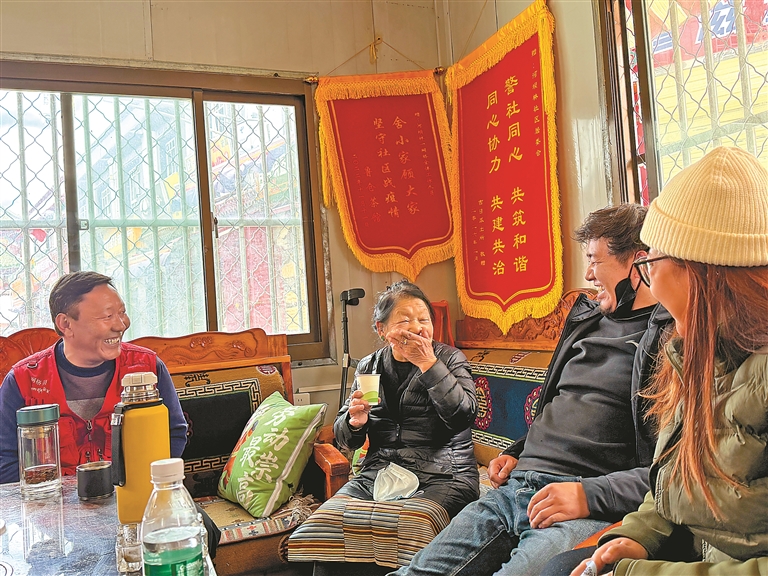
Halima (2nd, L) chats with community workers. [Photo/Mingji]
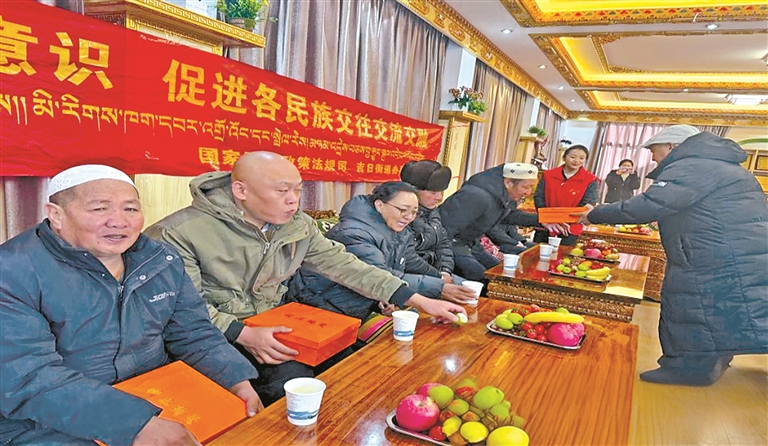
An ethnic unity symposium organized by Hebalin Community. [Photo/Hebalin Community]
Leafing through a bound 1960 edition of Xzang Daily, a lengthy feature from October 4 catches the eye. Titled "One Street in Lhasa," it paints a vivid picture of a city shaking off the past just one year after democratic reforms. "Walk into this street," the article reads, "and you’ll immediately hear the rhythmic whir of sewing machines, the crisp clang of hammer on iron, and the happy labor songs of residents."
Sixty-six years later, a reporting team marking the newspaper's 70th anniversary returned to that same thoroughfare. They followed 81-year-old Halima through her memories, sipped sweet tea in a timeworn teahouse, and watched the daily rhythms of a multi-ethnic neighborhood that has turned diversity into a quiet strength.
An elder's lifelong testament to unity
In the Hebalin Community, locals affectionately call Halima "our treasure." Dressed in Tibetan attire, her eyes soft with age, she has spent 56 years weaving herself into the fabric of this street.
Born a Tibetan girl named Penpa Drolma, she learned tailoring from her father and took on odd jobs—painting, hauling lumber—to get by. At around 25 years old, she married a Hui man named Zhao Boneng, and took the name Halima. Their home, an old courtyard called "Sukang," was rundown, the road outside a muddy track where dung carts raised clouds of dust.
Her husband, more than a decade her senior, spoke Tibetan, Chinese and English fluently and had a steady job. He treated her with kindness. She kept house, brought him lunch each day, and built a small, steady life.
Today, the couple's three-story home sits at a busy intersection. The hammering and labor songs are long gone, replaced by teahouses and shops humming from dawn to late night. Halima's in-laws originally came from Shaanxi Province and married local Tibetan women; the family has always been a mix of ethnicities, all speaking fluent Tibetan.
From mud-brick hovel to a solid multistory house, Halima has witnessed generations of Tibetan-Hui-Chinese kinship. Her ordinary days tell an extraordinary story.
A teahouse that holds time still
Tucked down a quiet lane, the Lucang Teahouse has roots reaching back to the 1920s. After a long silence, it reopened in late 1979 in the same old family home.
Ru Geiye, then 20, was the eldest daughter and helped her father run the place. It was bare-bones—wooden crates for tables, a big cup of sweet tea for 0.1 yuan. Customers left their coins on the table, and someone would pour tea and take the money.
Now 67, Ru Geiye has seen the old house rebuilt into a three-story structure. The teahouse occupies the first two floors, double its original size. She has never opened a branch. "I want to stay here, keep the old taste," she says. She is one of nine siblings; all the others had jobs outside the teahouse. Now retired, some have come back to help. The teahouse is both a livelihood and a family heirloom.
For 47 years, Lucang has been pulling together Lhasa's slow hours—sweet tea, Tibetan noodles, and the quietest kind of human warmth.
A neighborhood forged in diversity
"Hebalin" itself is a hybrid name: heba from Chinese meaning "river embankment," lin from Tibetan for "land by the water". It sits along the southern bank of the Lhasa River. The area's story of ethnic coexistence stretches back centuries.
Local Hui families are said to be descendants of Qing Dynasty garrison troops and merchants who arrived in the 18th century. Tibetans call them Gyakachi, and for generations they have run teahouses, restaurants and butcher shops. At the heart of the community stands the Lhasa Grand Mosque, built in 1716—300 years watching over a former Hui enclave that has grown into a harmonious home for 11 ethnic groups, including Tibetan, Han, Hui and Uyghur.
To handle everyday frictions—charging stations, plumbing repairs—the community launched the "Pomegranate Unity Courtyard Meeting." Neighbors sit together and talk things out.
Musa, an 85-year-old Hui man, has seen it all. "The changes are earth-shaking," he says. "You couldn’t describe them all if you tried."
Sixty-six years ago, a newspaper reported the rebirth of an old Lhasa street. Today, the people of that street are writing the next chapter—more quietly, perhaps, but just as powerfully—one cup of tea, one courtyard meeting, one family at a time.
Reporter: Xiao Yong, Chang Chuan, Mingji, Tsezhen, Langqing Tso, Losang Phuntso
Translator: Zhi Xinghua
Review: Phurbu Tsering, Drakpa Wangchen
Copyright © Xizang Daily & China Xizang News All rights reserved
Reproduction in whole or in part without permissions prohibited
Index Code: 藏 ICP 备 05000021 号
Producer: Xizang Daily International Communication Center