





Source:xzxw.com 2026-04-28
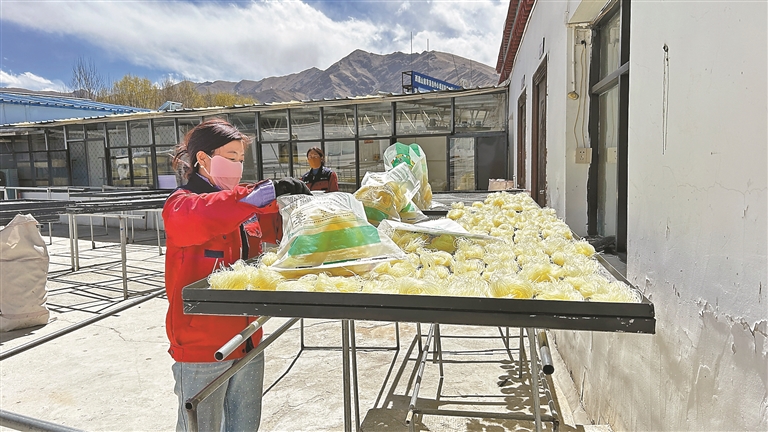
Photo shows that workers pack dried vermicelli at Tashi Delek's factory in Khesum Community. [Photo/ Wu Peitao]
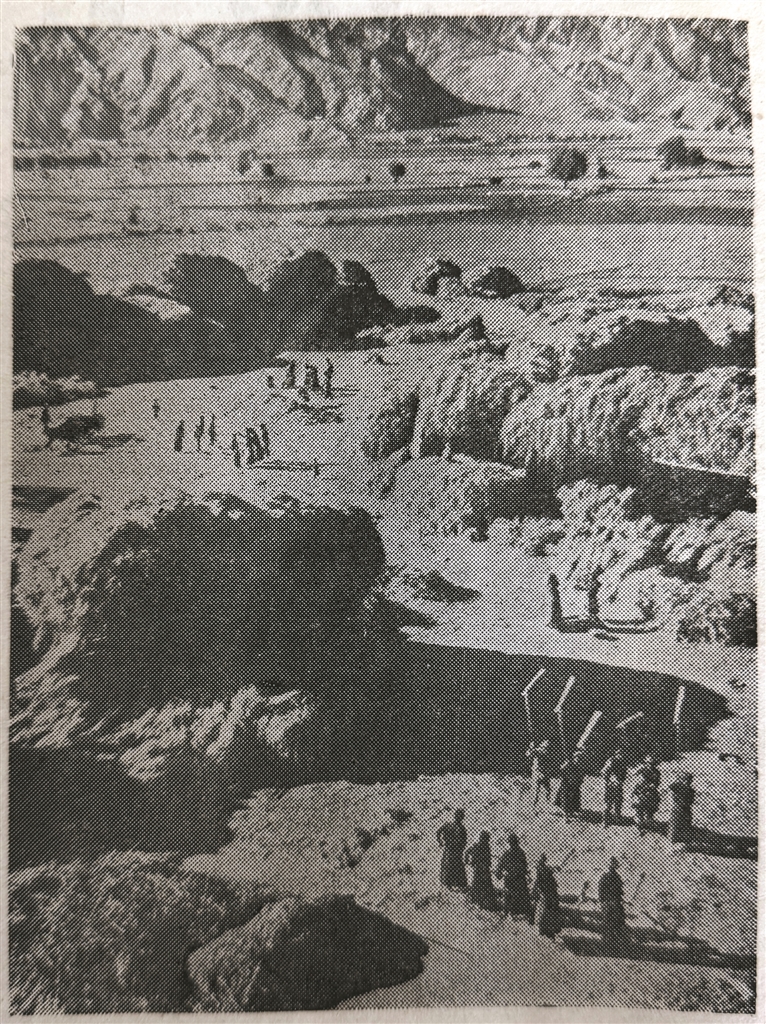
A Xizang Daily photo feature on 30 November 1963, "Khesum Manor Today", shows stacks of highland barley on the threshing ground of Khesum's first mutual-aid team. [File Photo]
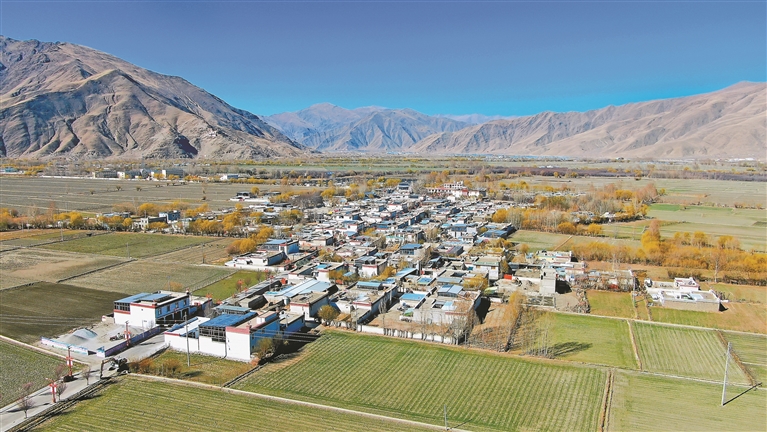
Photo shows Khesum Community today.
"The vast fields have been plowed and winter irrigation has begun. On threshing grounds all around, the rhythmic sound of flails blends with the joyful singing of women. From courtyards and kitchens wafts the rich aroma of roasted barley..."
On November 30, 1961, Xizang Daily published a long-form feature on its second page by reporters Guo Chaoren and Ngawang Tenzin, titled Old Manor, New Face. It vividly captured the "enormous and brand-new changes" unfolding in what would become known as "Xizang's first village of democratic reform."
As Xizang Daily marks its 70th anniversary, our interview team returned to Khesum to talk with villagers about the past, the present and the future — seeking answers to happiness in this historic red village.
An answer written the moment they "stood up"
"There's no comparison! Having lived through suffering, we understand today's life much better," said 84-year-old Party member Sonam Dondrup.
Khesum was once a manorial estate under the old serfdom; its people lived in darkness as serfs.
"When a child was born, even if the parents had too little to eat or wear, they still had to take hada (a traditional Tibetan silk scarf) and eggs to the manor lord to register the birth. Once the child turned eight, they had to shoulder a corvée labor," Sonam Dondrup recalled.
After the democratic reform, Khesum Village established Xizang's first farmers' association and its first village Party branch, completely rewriting the fate of its people.
Sonam Dondrup joined the Party in 1956 and served as a local cadre for many years. Back then, the village had five Party members, all full of revolutionary fervor, determined to show the public that the Communist Party's cadres were different: "No matter how heavy our own family burdens, we still helped the people. We thought of them in everything."
Yangzom, 57, is the daughter of the former serf Chigya. We met her while she was plowing the land with neighbors. "It's etched in my heart, never to be forgotten!" Yangzom spoke of the pain her parents endured, while expressing deep contentment with today's life. Her husband earns over 4,000 yuan (≈585 dollars) a month, her children are filial and sensible, and life is peaceful and happy.
The numbers bear witness to the transformation. By "standing up," the people of Khesum built a life of happiness on their own, leaving undeniable proof. Before the democratic reform, Khesum Manor housed 99 households with 302 people, and its more than 1,200 mu (80 hectares) of land belonged to the lord. Today, Khesum Community has 254 households with 886 people, 2,400 mu (160 hectares) of arable land, and a total grain and oil output of 985 tons in 2024.
An answer written the day they "went to school"
After the democratic reform, a primary school was built in Khesum, and more than 50 children of serfs entered the classroom.
The same 1963 photo feature carried a picture of two children. The caption read: Tsering Drolma and her younger brother Tsering Kelsang, children of the slave A'nai, became the first generation of literate people in this manor.
Tsering Kelsang, 77, recognized himself in the photo. "That's me," he said with pride. Stepping out of ignorance and into the classroom transformed the lives of him and his siblings. His sister became a teacher, his elder brother a grassroots cadre. Kelsang himself joined the military, returned to the village after his service, and now receives a full pension and lives comfortably in his later years.
"My daughter started in the village school and grew step by step into a cadre," he said with satisfaction. "The children have gone further than us , and life gets better with every generation."
Still full of energy, Tsering Kelsang often helps relatives by taking their children to and from school. Gazing at the bright, well-equipped classrooms, and the children running with their backpacks, he is full of hope: "These children's future will be filled with light!"
Education has carried the people of Khesum to wider horizons. The enrollment rate for school-age children in the village is 100%. Residents under 60 are literate. A total of 342 university students have emerged from this community.
An answer written in these years of "prosperity"
A modern factory by the roadside catches the eye. It is a vermicelli processing plant founded by Tashi Delek, who married into the village. In 2025 it sold about 380 tonnes of vermicelli, with a net profit of 1.18 million yuan (≈172,800 dollars). The product now reaches not only markets within the region but also places as far away as Guangdong.
"I couldn't have achieved this without the good policies of the Party and the government," Tashi Delek said. In the early days of his business, equipment was rudimentary, output low and market access limited. With policy and financial support, daily production capacity rose from 100 kg to 2,000 kg. He has also become a driver of local employment, engaging 320 villagers in total.
Khesum Village is rapidly growing more prosperous. According to Dekyi Peldron, the head of Khesum community committee, the community centrally manages its collective land and has built 88 vegetable greenhouses. At the same time, they strengthen the collective economy through various means, including commercial property and stage rental, and an agricultural machinery cooperative. In 2025, the community's per capita annual income surpassed 37,000 yuan (≈5416 dollars). A diversified structure of income channels — farming, animal husbandry, transport, and migrant work — has made people's lives increasingly secure.
This "prosperity" shows in quality of living. Drainage, lighting, and landscaping systems have been fully upgraded. A public square, a community service center, and an exhibition hall for ethnic handicrafts have been built. Residents now live in tidy, beautiful Tibetan-style houses, with an average living space of 87.5 square meters. Nearly every family owns a car, and road trips have become a new trend.
With thriving industries, happy families, a harmonious community, and a beautiful village, Khesum Community, under the leadership of the Party, is unleashing infinite development potential and internal drive as it races toward an even brighter future.
Reporter: Zhang Shanghua, Zhao Jiangfeng, Tenzin Phuntsok, Wu Peitao, Kelsang Drolma, Liu Wentao, Tang Qisheng
Translator: Yang Xiaofeng, Zhi Xinghua
Review: Phurbu Tsering, Drakpa Wangchen
Copyright © Xizang Daily & China Xizang News All rights reserved
Reproduction in whole or in part without permissions prohibited
Index Code: 藏 ICP 备 05000021 号
Producer: Xizang Daily International Communication Center