





Source:xzxw.com 2026-04-30
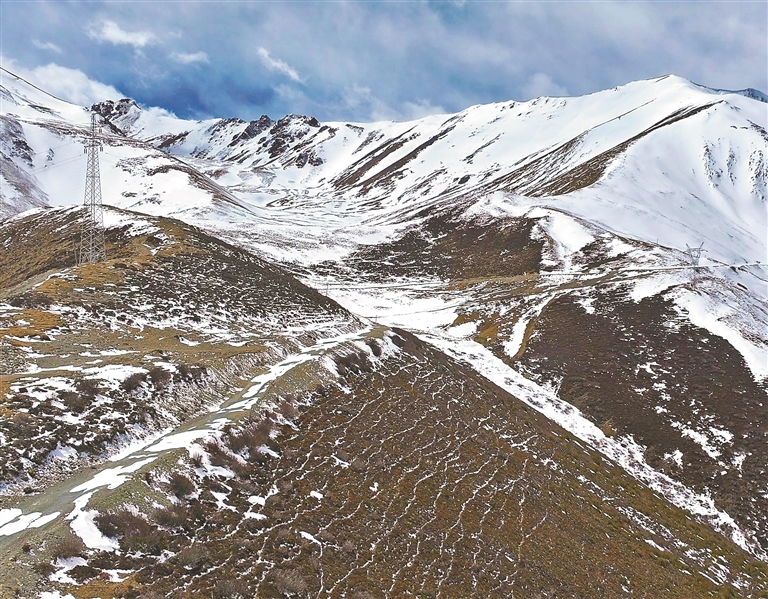
Photo shows the old road winding over Xiagongla.
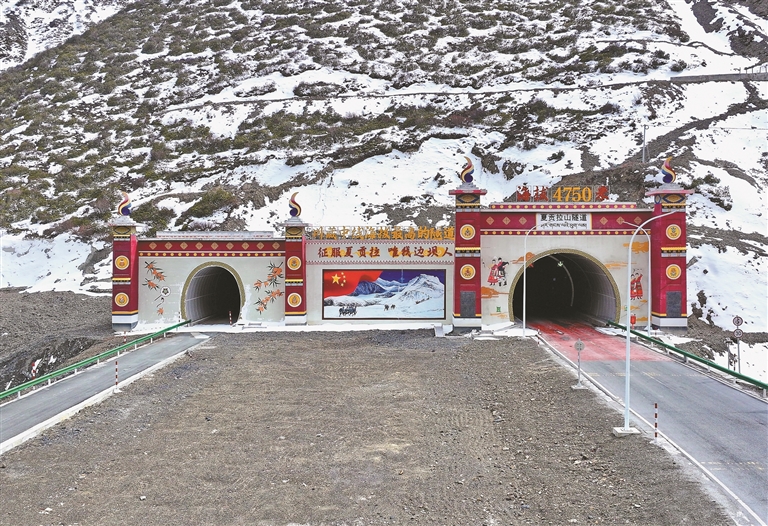
Photo shows a tunnel entrance at Xiagongla. [File Photo]
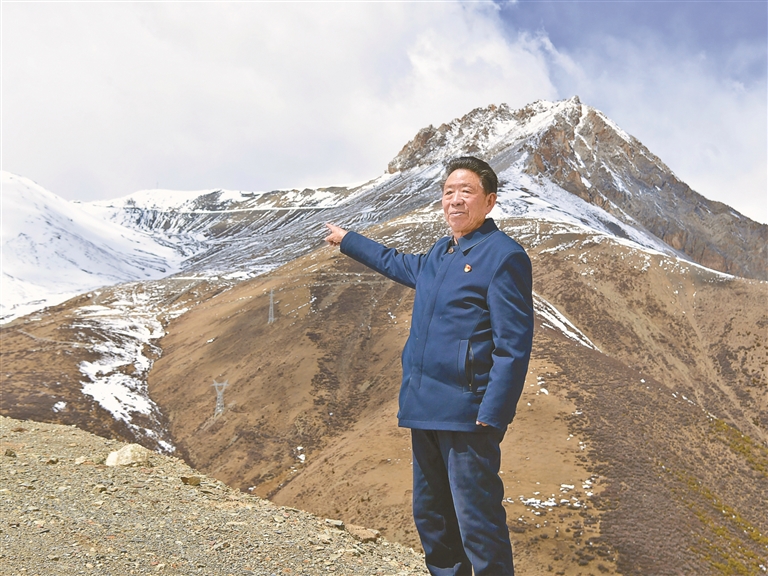
Photo shows that Nyishar, who worked on building the old mountain road, returns to the site. [Photo/ Sonam Wangchug]
On August 24, 1979, Xizang Daily published a report headlined "Palbar County Relies on the Masses to Develop Transport Infrastructure." It read: "Palbar County is a land of towering mountains and deep valleys... A horse ride takes three days. Every year, livestock carrying chemical fertilizer tumble into the Nujiang River."
Forty-six years later, in March 2026, our interview team arrived in Palbar County. Driving south from the county seat for just over twenty minutes, Xiagongla loomed ahead. The old road that once spiraled upward is now almost abandoned; gravel and snow have buried the tracks. It has been replaced by a 4,392-metre tunnel. A mere 8 minutes and 17 seconds, we emerged on the other side, already in Jiling Town.
The unscalable Xiagongla
Xarkang La means "eastern snow mountain" in Tibetan. At 5,290 meters above sea level, it was one of the most treacherous passes on the ancient Tea Horse Road, the official Sichuan-Xizang route, and the PLA's march into Xizang——known as the "most dangerous pass into Xizang." The peak is snow-capped year-round and the mountainside is often shrouded in cloud. Even in summer, crossing it required immense courage and stamina. For centuries, merchants and travelers passed this spot filled with dread.
Nyishar, 72, was born and raised in Palbar. Lean, his face etched with deep wrinkles, he recalled, "in the old days, from October to April of the next year, heavy snow sealed the mountain, and this road was closed." When he was young, riding from the county seat to Jiling Town took two days. Going to Lhasa meant a long detour via Chamdo or Nagqu — half a month, part on horseback, part by vehicle.
The 1979 report described "masses worked for two winters and springs to widen the path into a flat road capable of carrying tractors." That was the era of carving roads out of cliffs with drill rods, shovels, and old bulldozers. Without explosives, they would heat rocks with fire and then douse them with water to crack them open. Without machinery, they relied on human backs and pack animals.
Yet Xiagongla remained. Some roads cannot be finished in a single generation.
Tunneling through the "greatest peril"
In the 1990s, Palbar County secured a sum of road-building funds. Most was spent on simple tools: drill rods, shovels. The villagers who came to work received a daily allowance of just 1.8 yuan. But their enthusiasm ran high — men and women, young and old, all joined the effort.
On July 1, 1999, Nyishar, deputy commander of the road-building effort, led 18 people to the summit to place explosives. It was raining. They carefully laid eight charges — four on each side — along the ridge. Everyone hid behind boulders. "I shouted 'Ready!' and we all covered our ears. The instant the explosions went off, the rain suddenly stopped and the sky cleared. Sunlight hit the snow mountain, all golden and brilliant." Nyishar paused, his eyes reddening. "I felt then it was a good omen. Even heaven was helping us."
That year, the road was finally opened. It was just a gravel road, often washed out during the rainy season and still blocked by snow, but it was open. For the first time, the people of Palbar could drive a tractor up Xarkang La. On the day it opened, many villagers stood by the road and wept. The journey that had taken their ancestors half a month could now be completed in a few days.
Over the next two decades and more, the road was extended inch by inch. From dirt track to gravel, from gravel to asphalt, from the winding mountain pass to a tunnel through the mountain. On September 29, 2024, the 4,392-metre Xiagongla Tunnel officially opened to traffic, marking the full completion of National Highway 349. The road distance from Palbar to Lhasa was slashed by nearly 300 kilometers. Winter closures became history. Palbar is no longer a dead end — it has become a "bridgehead" integrating Chamdo into the economic circles of Lhasa, Nyingchi, and Nagqu.
Consigning "difficult access to Xizang" to history
We passed through Xiagongla in 8 minutes and 17 seconds. Two old songs on our phone hadn't even finished, and the mountain was already behind us.
That absurdly short time brought to mind a yellowed photograph in the Palbar County History and Culture Exhibition Hall — a group of soldiers warming their hands by a fire, behind them knee-deep snow. To write slogans, they had to mix ink with sugar water. The ink froze into ice, and their hands went numb, so they would rub them together and keep writing. It took more than an hour to write just over 20 characters. No one remembers their names, yet today everyone who passes through this tunnel unwittingly joins a conversation with them.
Nyishar wept the day the tunnel opened. "It's not that I can't bear to let go of the old road," he said. "It's that I can't bear to let go of those who never came back." His words stayed with us all the way. For people like Nyishar, the phrase "difficulty of travel" is not just history on paper — it is a memory carved into their bones.
It has been said that the history of transport in Xizang is a history of "turning the impossible into the possible." By the end of 2025, the total length of roads open to traffic in Xizang had reached 125,200 km. And it's not just Xiagongla — Mon La, Jokbam, Ngala ... a succession of extra-long tunnels have consigned "climbing mountains" to history. Beyond roads, there are railways: the Qinghai-Xizang, Lhasa-Xigaze, and Lhasa-Nyingchi lines now form a "Y"-shaped railway, with the region's railways in operation totaling 1,187.8 km. A transport network also spreads across the sky: Xizang has built eight civil transport airports serving 204 air routes. Soaring aircraft, winding expressways, tunnels that pierce mountains, railways that leap across rivers — behind them are flesh-and-blood people who, over decades, ushered "difficult access to Xizang" into history, while creating a new history.
Awakened landscapes, flourishing livelihoods
Once the tunnel opened, the beauty deep in the mountains was suddenly revealed to the outside world.
Tricolor Lake, at an altitude of 4,100 meters, features three distinct bodies of water — White, Yellow, and Black — believed to be the world's highest natural tri-colored lake. Glacial meltwater feeds the lakes, and when sunlight hits the surface, it refracts into different hues. Phayum First Village, nestled near the lake, used to be one of the most isolated spot in the area. Today, an asphalt road reaches the glacial lake shore. Smoke curls up from guesthouses, and university graduates from the village have turned into livestream sales hosts. In recent years, tourist numbers at Tricolor Lake have soared. Data shows that Phayum First Village has received nearly 120,000 tourist visits, generating millions of yuan in tourism revenue for the village, with per capita disposable income above the regional average. Tenzin Dekyi, 8, has become a minor celebrity in the guesthouse — a business her father Dorje started a few years ago, the first Tibetan-style guesthouse in the village, which now brings in a substantial income.
Within Jiling Town, contains a forest of ancient sea buckthorn that has grown naturally for over a thousand years along the Xagqu River. Stretching for more than ten kilometers and covering over 3,000 mu (200 hectares), some of the trees are so thick that five or six people together can barely reach around their trunks. These places, once unknown to almost anyone, have now become must-visit spots for self-driving tourists. With tourist numbers growing year after year, the county's total tourism revenue has climbed steadily.
What was once the "most dangerous pass into Xizang" is becoming a tourist hot spot.
With the influx of people, industries came to life. In Buzha Village of Palbar Town, a factory has been established to produce the three-colored hada, traditional Tibetan silk scarves, which have already achieved their first export: ten thousand hatas were shipped from the Palbar Industrial Park to Kazakhstan. In Nyinmo Town, a forest musk deer breeding base has filled a gap in artificial breeding of the species across Xizang, with a standardized industrial base housing nearly 300 animals. The Palbar Tibetan chicken breeding center now holds a stock of over 20,000 birds, with a deep-processing production line in operation and sales climbing continuously. There are also black goats, Jersey cattle ... one by one, industrial chains have taken root deep in the valleys, and people's lives are looking ever more promising.
Half a month, one day, 8 minutes and 17 seconds, a seven-day parcel delivery to the town — time has been redefined at Xiagongla, and the awakened landscape has been rediscovered by the people.
Xiagongla is still here — towering and majestic as ever. But it is no longer a natural barrier that made passage almost impossible.
Just like today's Xizang, where a three-dimensional transport network is pulling every corner into the fast lane of modern civilization.
Reporter: Zhou Tingting, Migmar, Sonam Chosphel, Gonchuk Chogtso, Phuntsog Namgyal, Sonam Wangchug
Translator: Yang Xiaofeng, Zhi Xinghua
Review: Phurbu Tsering, Drakpa Wangchen
Copyright © Xizang Daily & China Xizang News All rights reserved
Reproduction in whole or in part without permissions prohibited
Index Code: 藏 ICP 备 05000021 号
Producer: Xizang Daily International Communication Center