





Source:xzxw.com 2026-05-12
Shale is a sedimentary rock formed from clay that has been compacted, dehydrated, and cemented over hundreds of millions of years. As thin as book pages and stacked like mountains, it records the earth's transformations.
In Mancun Village, Shaogang Township, Kangmar County, Xigaze, the shale from Wuba Mountain is nature's most simple gift. Fine-grained, soft-textured, and thinly layered, it can be easily split into sheets with a hammer and chisel — a naturally flat "stone paper."
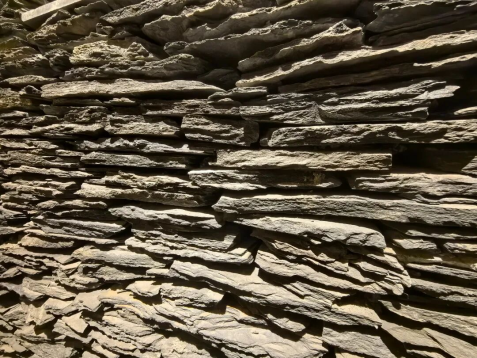
Stone is inherently lifeless. But once held in a craftsman's hand, when the carving knife falls and lines begin to flow, it gains warmth, gains stories, and gains a vitality that transcends time.
Guo Jiquba, the fourth-generation inheritor of the Kangnuo Mani Stone Carving technique, has been connected to stone since childhood. "As a child, I would watch my father and uncle carve, and I would pick up the scraps on the side, imitating their movements — drawing lines and chiseling patterns stroke by stroke," he says.
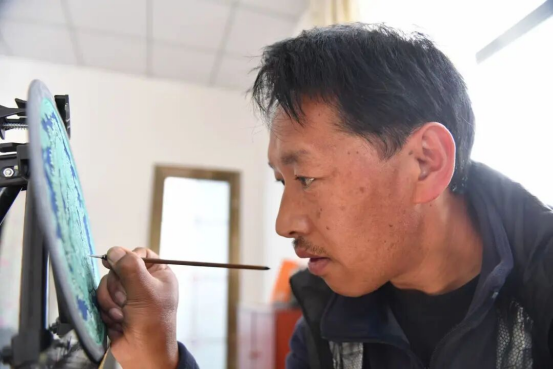
Guo Jiquba's apprentice carving a piece
The craft passed down by his ancestors flowed through his fingertips and settled over the years. Later, attending school, leaving his hometown, and working temporarily took him away from stone carving. Yet the longing for stone in his heart never died out.
An opportunity to restore an ancient monasterybrought him together with a group of like-minded folk artisans — clay sculptors, painters, embroiderers... different crafts, but the same passionthat deeply moved him and rekindled his nostalgia for the feel of a carving knife across stone. "During the time I was learning clay sculpture, I would often get so immersed that I'd forget to eat, working until one or two in the morning," he says.
In 2005, Guo Jiquba resigned from his job in Lhasa, and using his savings, opened a tourist restaurant in Xigaze City. To help more people see the value of shale, he brought raw stone from his hometown, carved and colored it, and placed the pieces in a corner of his restaurant in Xigaze. Unexpectedly, these works with their highland characteristics appealed to many tourists, bringing in numerous orders.
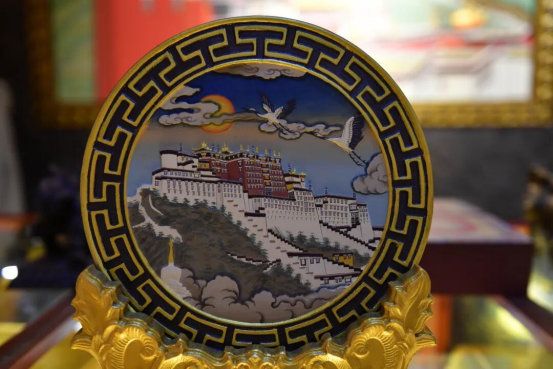
Guo Jiquba's carved works
While overjoyed, Guo Jiquba also secretly made up his mind to truly bring the stones of his hometown to life. And he sold his restaurant in the city, packed his bags, and returned to his hometown to focus on stone carving.
This decision caused a hot discussion in the village.
His family didn't understand: "You've already made it to the city — why come back?"
Villagers scoffed: "Do you think you can turn this worthless stone into gold?"
He didn't argue. He exchanged his land for an empty plot at the village entrance, found a few villagers to help, and built a small stone materials factory.
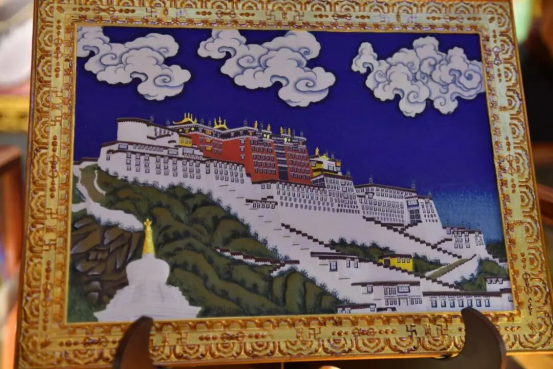
Guo Jiquba's carved works
Recalling this experience, Guo Jiquba smiles, his gaze slowly deepening, carrying the reflection of the road traveled — with ruggedness, release, and above all, a steadfastness after the storms. "Only later did I realize that it wasn't me who chose stone, but stone that chose me. Born on this land full of shale, this is what I was meant to do," he says.
And the shale did indeed "choose" him. Its moderately soft and hard texture withstands the precise movement of the blade, allowing smooth lines and distinct layers. Its fine surface is a natural canvas, perfectly compatible with Xizang's mineral and plant pigments, retaining color for ages without fading.
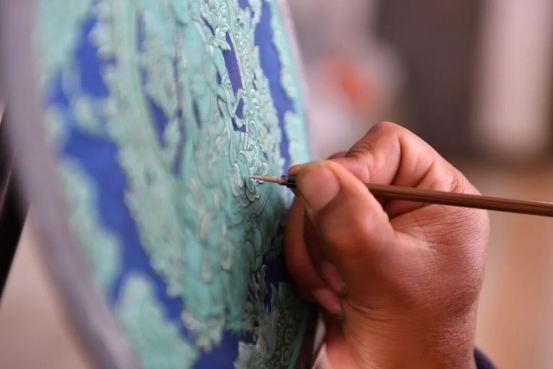
Guo Jiquba is carving a piece
Kangmar County has a long history of stone carving. From the late Yuan to early Ming dynasties, the Shaogang Cliff Carvings still stand today. The Kangnuo Mani Stone Carving technique, which integrates quarrying, carving, and painting, is almost tailor-made for this material — shale.
What Guo Jiquba needed to do is follow his heart and pursue his passion.
In the early days of the factory, shale was only processed into simple building materials. "In Xizang, shale can be used not only for building houses and paving floors, but also in landscaping, scenic spots, and hotel decoration," he recalls. In his spare time, he loved sitting on the hillside, stroking the stones in his hands. He always felt that while the stones from his hometown had many uses, they had never truly "shined."
"Stone should not just be used for paving roads, but should also become a carrier of culture," he says. "Traditional stone carving techniques are nearly lost, and there is no mature modern technology that can replicate them."
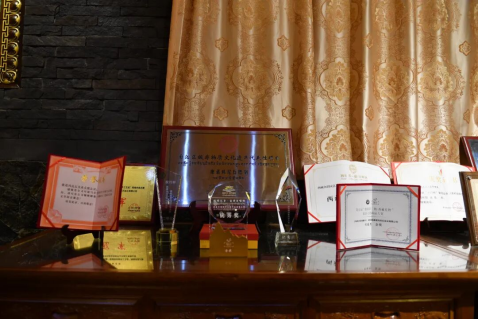
Various certificates of honor received by Guo Jiquba
This is both a regret and a direction.
In 2014, with the support of the Xizang's policies, Guo Jiquba successfully established Kangmar County Kangnuo Mani Stone Industry Co., Ltd., integrating shale quarrying, processing, and sales. To improve production efficiency, he visited stone carving machinery factories across China. In 2015, he went to Shandongfor on-site inspection, sent shale samples, and customized suitable carving machines. To recover the nearly lost techniques, he sought out carving artisans everywhere, meticulously documenting the fading skills and incorporating them into his own works.
Calming himself to "converse" with stone — this was his way of making flowers bloom on stone with each stroke of his chisel.
In August 2015, at the China-Russia Expo, Guo Jiquba's exquisitely crafted Kangmar Mani Stone Thangka pieces made a stunning debut. Amid exclamations of "I never knew such beautiful carvings could be made on stone," shale stepped out of the highlands, and the traditional carving technique that had been dormant for years was seen by more people.
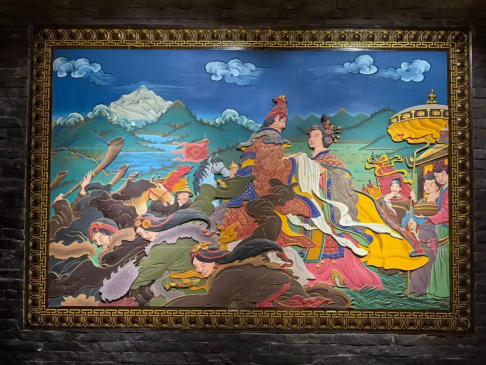
Guo Jiquba's carved works
Guo Jiquba deeply understands that an intangible cultural heritage craft is never the persistence of one person or one matter, but a responsibility passed down through generations. To this end, he has trained six apprentices, teaching them hands-on the nuances of the carving knife. He has led his team in developing three product lines — ethnic building materials, folk carvings, and stone powder products — bringing shale out of the remote mountains and into more people's lives.
This ancient craft, rooted in the fertile soil of the plateau, rejuvenates itself in step with the times. Using stone as paper and his knife as a pen, he carves not just distinctive culture. On the occasion of the Dingri earthquake, he carved "unity is strength." On the 60th anniversary of the founding of the Xizang Autonomous Region, he carved "celebrating prosperity."
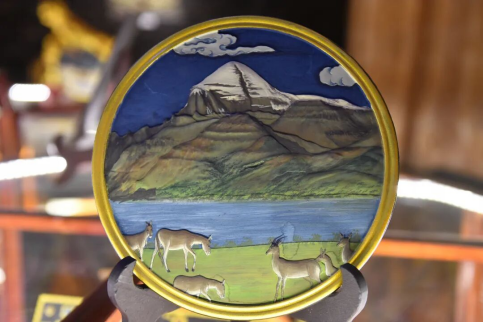
Guo Jiquba's carved works
Stone is silent, but the artisan's heart speaks. The Earth wrote its story in the stone; he carves his story onto the stone. One is an epic of geology; the other, a footnote to a life. Two forms of writing meet on the same stone. Each chisel and stroke records the pulse of the era.
Copyright © Xizang Daily & China Xizang News All rights reserved
Reproduction in whole or in part without permissions prohibited
Index Code: 藏 ICP 备 05000021 号
Producer: Xizang Daily International Communication Center