





Source:xzxw.com 2026-05-14
As a crucial ecological safety barrier for China, preserving every plant and animal, mountain and river in Xizang is not only a responsibility but also a foundation for development.
How can these ideas be put into practice? How can conservation and development proceed hand in hand? Where should the livelihoods of local people be placed?
Our reporter recently visited Sagya County in Xigaze with these questions in mind. On this land with an average altitude of over 4,000 meters, a clear path to green development has emerged — from the transformation of vast sandy lands in Xongmai Township, to the symbiotic green ecosystem of the CNNC wind-solar-storage power station, and to the circular transition of the stone industrial park in Jiding Town.
From "Desert Advances, Human Retreats" to "Green Advances, Desert Retreats": A protracted battle againstsand and wind
Some memories are etched into the skin.
In Xongmai Township, where Sagya, Dinggye, and Tingri counties meet, sand and wind were once a shared pain for generations. Jamyang, secretary of the Party branch of Quwa Village, recalls a childhood shrouded in yellow dust: "After washing up and leaving the house clean in the morning, by noon, sand would be in my hair and nostrils."
When the wind picked up, it stung your face. Pastures where livestock grazed were repeatedly buried;young barley shoots were snapped as soon as they emerged. Staying indoors unless necessary became the only way to avoid that.
The turning point came in 2020 with the launch of an ecological sand prevention and stabilization project — a total investment of 27.8417 million yuan(RMB) covering 4,000 mu (about 267 hectares).
"In 2004, I drove trucks through Xizang and passed by here — the sandstorms were so fierce the sky turned yellow," says Guo Yuanfu, the project leader and a witness and commander of this green battle. "I never imagined that over a decade later, I would be part of the team helping to tame this desert."
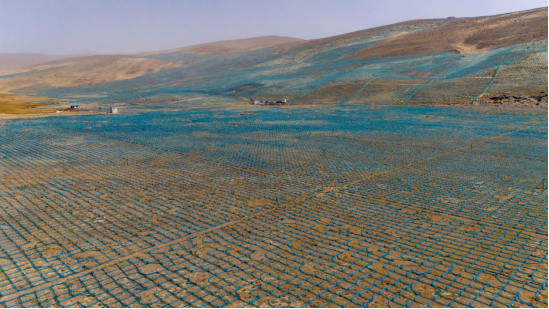
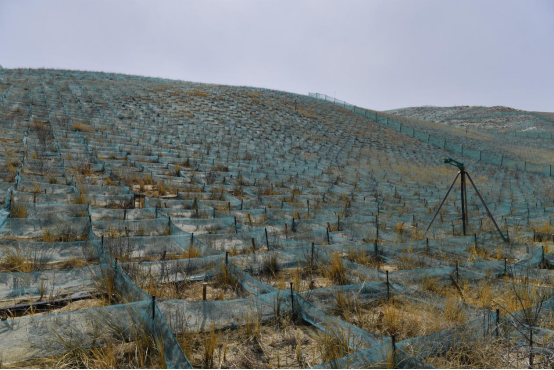
Planting trees on the cold, arid sand was no easy feat. Guo recalls that in the first year, only six rains fell. Most of the seabuckthorn and willow saplings planted that year did not survive the cold and drought in winter — their survival rate was heartbreakingly low. Adapting to the high-altitude, dry, and low-temperature climate, the team used HDPE sand-blocking and sand-fixing net to stabilize dunes, while selecting Hippophae gyantsensis, native willows, Artemisia sphaerocephala, and Hedysarum scopariumfor afforestation and grass seeding.
But the difficulties did not deter the team. They stayed in the sandy trenches, irrigating without fail every 15 days during dry spells and tending each sapling like a baby. They completed winter and spring irrigation on schedule, replanted where necessary, and sowed grass seeds. With the coordinated efforts of the local government, professional field teams, and engaged villagers, ecological restoration progressed steadily.
Small changes added up. Data shows that sapling survival rates in sandified areas now exceed 85%, and the number of windy, sandy days has decreased by 15 per year.
But more telling than the numbers are people's feelings.
"The wind and sand used to be most ferocious in April. Now it's calm. The sand no longer hits your face, and breathing feels easier," Guo Yuanfu could hardly contain his joy.
Since 2022, dust has visibly decreased and ground vegetation has recovered, with villagers spontaneously joining tree-planting and maintenance efforts — transforming from bystanders into the most steadfast guardians.
What is more surprising is that with revived vegetation, rainfall has also increased. In 2023, about 26 rains fell locally. Wetlands have expanded, and black-necked cranes, bar-headed geese, and ruddy shelducks — the "plateau spirits" — have returned.
In a village once impossible to stay in outdoors, locals now bath in the sun and chat outside their homes. Revitalized pastures have freed agriculture and animal husbandry from sand interference, bringing stable growth.
During the project's implementation, over 250 villagers took part in ecological construction, earning a total of more than 1.5 million yuan(RMB).
From the relentless advance of sand to the steady return of green, Xongmai Township has built a green Great Wall after years of effort.
A symphony of wind and sun: Letting green electricity flow andpastures thrive
If Xongmai Township is about "treating sand," then the CNNC wind-solar-storage station in Sagya reveals a different kind of wisdom — how to "coexist" with nature.
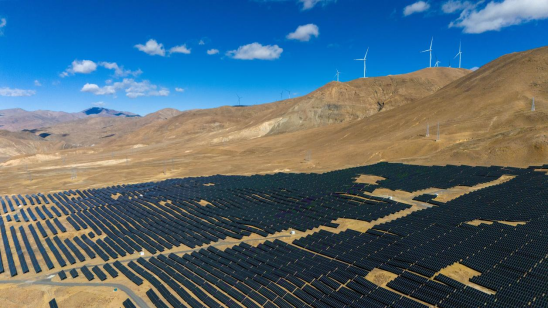
From the project's vantage point, a picture of technology and nature in harmony unfolds: across the vast land, white wind turbines turn in the wind, photovoltaic panels glint in the sun, blending beautifully with blue skies, green grass, and distant mountains — a unique ecological portrait of the Sagya CNNC station.
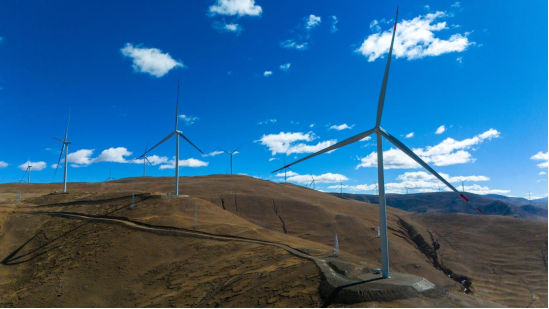
"Plateau turf and soil are treasures. Once damaged, they take centuries to recover," says Guo Xingxiang, the station's manager, capturing the essence of building in an ecologically fragile area.
How to protect? During construction, the project strictly followed the principle of "minimum disruption, maximum protection," adopting an innovative turf transplanting technique. Simply put, they removed turf from construction areas, carefully stored and nurtured it elsewhere, and then replanted it once work was completed.
This delicate, precise approach preserved native vegetation roots as much as possible. Meanwhile, slope stabilization and grass seeding were carried out simultaneously to prevent erosion and dust.
After completion, fine-scale ecological restoration continued. For areas like access roads, measures such as spray seeding and microbial restoration pushed vegetation survival rates from 60% to over 85%, reducing land degradation by nearly 30%.
The project also prioritized protecting plateau biodiversity.
During planning, it actively avoided nature reserves, wildlife habitats, and bird migration corridors. During operation, it established routine monitoring.
For all types of waste generated during construction and operation, a full-process disposal system was set up: household waste collected and transported; construction waste sorted and recycled; hazardous waste handled professionally — all with zero pollution, protecting the plateau's pristine ecology.
The station integrates wind, solar, and storage. It uses a model of "purchasing wind turbine sites and leasing photovoltaic sites," ensuring the interests of herders are protected. Pasture restoration continues, with extra grass seeding during rainy seasons. This approach helps sandy grasslands recover while also providing windbreak and sand-fixation benefits.
"We sow grass seeds under the photovoltaic panels and in open areas, and we have opened six grazing passages, allowing herders to graze at designated times — achieving dual-use land and a win-win for grazing and power generation," says Luo Musha, a station officer. This model resolves land-use conflicts between renewable energy development and traditional herding. For power supply, the station delivers an all-weather system — solar by day, wind at night, with storage as backup — greatly improving regional stability.
It is estimated that the station sends 320 million kWh of clean electricity annually, equivalent to saving 96,000 tons of standard coal and reducing CO₂ emissions by 249,600 tons per year.
No waste, only misplaced resources: A green closed loop in an industrial park
Ecological restoration has brought back green mountains and clear waters; clean energy provides development momentum. But how can industries themselves turn green? The stone industrial park in Geding Town, Sagya County, offers a solution: link upstream and downstream enterprises into a chain, turning waste into raw materials.
The park is not home to just one type of business. Stone processors, aerated block producers, sand-and-gravel plants, commercial concrete stations — and a cement plant — are all connected in a closed-loop chain.
It starts with stone processing. In the workshop, cutting machines hum as workers cut, carve, and polish local natural stone into various products. Chu Fengping, an enterprise leader, says the benefits of fine-processing are twofold: the products are durable, wind-resistant, and suited for the plateau — while also reducing dust and debris at the source, easing downstream treatment.
But the real ingenuity lies beyond the workshop.
Three types of "waste" are generated: slurry, fine sand, and leftover scraps. Under traditional rough models, these are pollution sources — taking up space, raising dust, and seeping into the soil.
The park's approach ensures that every type of waste finds a destination.
Take slurry. The park has sewage treatment equipment that separates the slurry from the production process. The sediment goes one way, clean water the other. The sediment is sent to the aerated block plant next door, becoming raw material for aerated blocks. The clean water returns to the production line for reuse — zero waste, zero discharge.
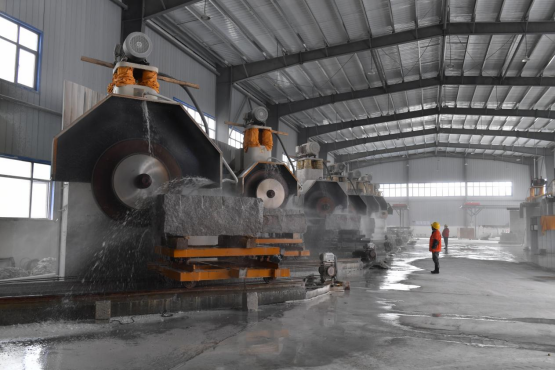
What about leftover scraps? Stone chips from cutting and carving go to the sand-and-gravel plant for secondary processing into crushed stone. That crushed stone then goes to the commercial concrete station as raw material.
As for the fine sand? Also to the aerated block plant, where it goes through crushing, proportioning, pressing, and curing — turning into lightweight, eco-friendly aerated blocks.
And there is more. Kiln dust from the cement plant's annual maintenance is also taken by the aerated block plant. Once a headache as industrial solid waste, it is now mixed into raw materials to press more blocks.
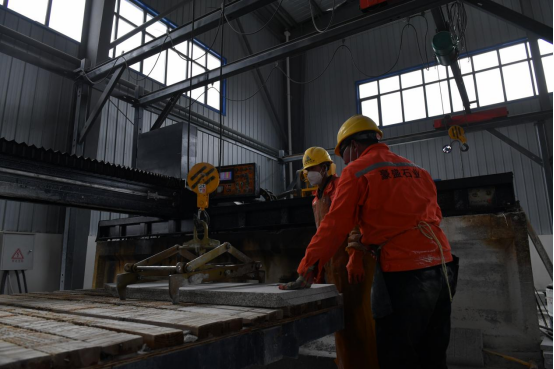
Yang Jian, Party Secretary of Geding Town, says the core of this process can be summed up in four words: everything in its rightful place. Environmentally, solid waste stays in the park; dust does not spread; wastewater does not leak — preventing ecological pollution from the start. Economically, waste disposal costs drop, raw material costs fall, and downstream industries thrive.
"Waste does not leave the park, pollution stays put, and enterprises solve their problems door to door," Yang says. From raw stone to carved product, from piles of waste to multiple building materials — green development means thinking through every step and connecting them. Connect them, and waste becomes treasure. In the future, the park will continue strengthening its closed-loop model, optimizing resource recycling, improving environmental production facilities, and steadily transforming toward greener, low-carbon, circular industries.
Sand no longer stings the face. Wind turbines and pastures coexist. Waste becomes raw material. Sagya's practice is not a simple copy of grand theory — it is a step-by-step grassroots exploration.
By preserving the plateau's ecological foundation, not only can green mountains and clear waters be restored — "green" can also be turned into gold, blazing a new path that prioritizes ecology and pursues green development.
Reporter: Tseji, Hu Rongguo, Yang Ziyan, Wang Li, Tenzin Namse, Tenzin Karmar
Translator: Zheng Yujie, Liu Fang
Review: Drakpa Wangchen, Hu Rongguo
Copyright © Xizang Daily & China Xizang News All rights reserved
Reproduction in whole or in part without permissions prohibited
Index Code: 藏 ICP 备 05000021 号
Producer: Xizang Daily International Communication Center