





Source:xzxw.com 2026-05-28
Yangjen, 58, has run a guesthouse called Shanjiu in Sakya County for most of her life. It is just a five-minute walk from the pedestrian street of Sakya Monastery. Room rates range from 30 yuan to over 200 yuan — modest or comfortable, as guests prefer.
In 2025, one figure stood out in Yangjen's ledger under revenue: one million yuan. Running her fingers over the page, she began planning a major move — tearing down the old building and investing 20 million yuan to construct a brand-new, modern hotel.
Yangjen keeps her own household accounts. Meanwhile, Sakya County as a whole has been keeping three big accounts: a cultural account that builds confidence, a service account that shows sincerity, and a livelihood account that delivers warmth.
In recent years, Sakya County has set its sights on becoming a strong county in culture, tourism and cultural relics. With the creation of a national 5A-level tourist site at Sakya Ancient Town as the main driver, it has focused on both preserving and revitalizing its millennia-old heritage and on forging higher-quality tourism, continuously burnishing its core brand: "The Dunhuang of the Snowland— Millennia-Old Sakya." In 2025, Sakya County welcomed 1.026 million tourist visits, generating total tourism spending of 185 million yuan, with the total output value of the cultural tourism industry reaching 305 million yuan. Compared to 2021, tourist visits grew by 164 percent, and tourism revenue by 159 percent.
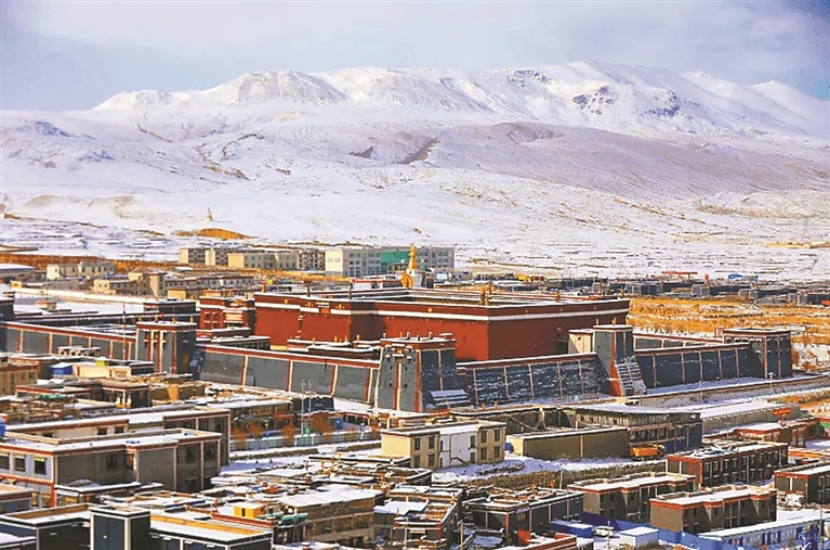
Photo shows aerial view of Sakya, the ancient town in snow. (Photo:Tenzin Gawa)
Cultural account: giving ancient texts and murals a voice
Understanding Sakya requires an attitude of reverence.
It houses over 84,000 volumes of ancient texts and documents, hundreds of palm-leaf sutras that have traversed a millennium, and more than 10,000 square meters of murals painted with natural mineral pigments. From monumental scriptures to breathtaking art, from historic architecture to living intangible cultural heritage, Sakya is an irreplicable cultural highland.
Over a thousand years, the civilization of the snowy plateau has found its most tangible form here.
But silent treasures require guardians. Over the past five years, Sakya County has adhered to the principle of "protection first, strengthened management, and rational use," systematically building a protective shield for its cultural heritage.
This account reflects reverence for history.
Forty million yuan in national cultural relic protection funds has been deployed, with fire safety, security, preventive conservation, and restoration work carried out comprehensively. Nearly 130,000 movable cultural relics at Samling Monastery have been catalogued, laying a solid foundation for research. The field monitoring team for cultural relics has grown from nine members to 26, strengthening patrols. The fourth national cultural relics census has been steadily advanced, with 161 heritage sites surveyed and 63 newly discovered — results that rank among the best in the city.
Yet protection is not the endpoint. The real “income” in this cultural account is bringing the words in ancient texts back to life and animating the heritage spread across the land.
Based on census data, Sakya County has built a database of its intangible cultural heritage treasures and compiled a collection of materials on immovable cultural relics. Long-sealed scriptures, weathered by time, are gaining new life through modern technology. The“Sakya Monastery Cultural Relic Protection Plan” has been issued, and the Sakya Cultural Tourism Service Management Center (Cultural Relics Institute) — the first such institution at the section-chief level among Xigaze’s 18 counties and districts — has been inaugurated, providing solid professional support for the integration of culture and tourism.
Intangible cultural heritage is the core of living transmission. Sixty activities bringing intangible heritage into schools and villages, and five special training sessions, have immersed people in traditional culture. Promotional exhibitions and sales events marking "Intangible Cultural Heritage Day" were held annually from 2021 to 2025, drawing enthusiastic crowds. To date, Sakya has successfully registered one national-level, 14 regional-level, 20 city-level, and 89 county-level intangible heritage items. Special protection funds are precisely channeled, with 340,500 yuan allocated for the emergency protection of the national intangible heritage item, the“Sharba Gong Opera”.
To bring Sakya's culture to wider audiences, a combination of publicity measures has been rolled out effectively.
Over a hundred short videos and illustrated articles have been promoted through mainstream media. Leveraging the partnerships forged through aid-Xizang programmes, cultural tourism promotion has reached 12 cities, including Hong Kong, Shanghai, and Nanjing. Well-known figures have been invited to serve as ambassadors, telling Sakya's story in a more contemporary style.
Visibility brings visitors, and visitors bring business opportunities. Thangka paintings, Tibetan incense, silverware, masks and other intangible heritage products have transformed from "fingertip craftsmanship" to market hits, generating cumulative revenue of approximately five million yuan.
In the final reckoning, the cultural account adds up to inheritance — and confidence.
A service account: slowing down passing footsteps
In the era of integrated culture and tourism, scenic areas are the carriers and service is the yardstick.
How do you give travelers a reason to stay in Sakya? Sakya's service account is all about the details — and about sincerity.
Today’s Sakya boasts a revamped ecological wetland park, clean and convenient tourist toilets, and an education base for ethnic unity and progress— all reshaping perceptions of the ancient town.
The transformation stems from substantial investment. Over the past five years, Sakya County has advanced 20 key cultural tourism projectswith total investment exceeding 600 million yuan, 17 of which are already operational. Every sum spent has gone exactly where it matters — ensuring every step a traveler takes is pleasant, every breath reassuring.
Anchored by the creation of the Sakya Ancient Town 5A-level Scenic Area, over 42 million yuan has been precisely invested in benchmark-upgrading projects. A creative cultural block has been meticulously developed. Thirteen tourist oxygen stations have been built and put into service, giving rise to the "Sakya Oxygenates You" (Sakya Yang Ni) service brand — a playful promise packed with sincerity. At high altitudes, this oxygen care has truly warms the hearts of visitors.
At the same time, the tourist center and smart parking lots have been fully upgraded. From parking guidance to tourism information, from signage systems to emergency support, services are being aligned with 5A standards.
Tourism is not a fragmented checklist of scenic spots, but a complete immersive experience. Sakya County has focused on the entire chain of "food, accommodation, transport, sightseeing, shopping, and entertainment," fostering high-quality venues such as the Naicang Hotel, Phuntsog Kangsam guesthouse, fancy Tibetan dining hall, the creative cultural block and an art space station. A cultural tourism complex integrating accommodation, dining, creative products, and experiences has taken initial shape.
By day, explore the ancient town and view the murals; by night, stay in a Tibetan guesthouse, savor hearty Tibetan cuisine, and enjoy Sakya's nightscenary. The role of tourists is shifting — from "passing through Sakya" to "staying in Sakya, playing in Sakya, falling in love with Sakya."
"This place is so beautiful!" exclaimed anItalian tourist Rosa Perpina. "We really love it. We've decided to stay tonight and see Sakya by night."
That single word— "we've decided to stay" — is the best receipt for this service account. Clear signage, clean streets, and thoughtful service make Sakya’s appeal extend well beyond its monuments.
From transit to overnight stay, from sightseeing to immersion, Sakya has won the vote of confidence that tourists cast on account of their experiences through quality and warmth.
the service account adds up to reputation — and goodwil.
A livelihood account: filling the people's pockets
The development of the cultural tourism must ultimately enrich the people and strengthen the county. This third account is about livelihoods and people’s sense of gain.
On Sakya County's creative cultural block, at the store of the Lhaso Tashi Traditional Mask Culture Communication Co., Ltd., Tashi, the owner, is explaining the core techniques of mask-making to visitors: "Making the base mold is the top priority. The clay must be finely sieved, the water just right, and an appropriate amount of animal hair must be added so the mold is tougher and fits the shape better." On the shelves, masks that blend traditional heritage with modern design have become focal points for tourists — preserving intangible cultural heritage while broadening local income channels.
As a regional-level inheritor of mask-making intangible heritage, Tashi has boldly innovated to help the old craft keep pace with the times, transforming the large masks originally used in Qam dance performances into smaller cultural-creative products that are easier to display and collect.
In 2025, this store generated 200,000 yuan in revenue.
From a folk workshop to the forefront of the market, the evolution of Tashi's masks is a vivid entry in this livelihood account.
In recent years, Sakya County has developed an "enterprise + village collective + farmer" employment model, enabling more and more people to earn a living from tourism right at their doorsteps. Statistics show that over the past five years, the county has provided a total of 417 jobs, employing 360 people of local people and generating over 22 million yuan in incomegrowth. This account is written in the smiles of the people.
Local girl Kelsang Drolma is one of the beneficiaries of this account. Through open recruitment, she became a salesperson at the "Converging Love for Sakya — Sakya Gifts" cultural-creative gallery. Dressed in Tibetan attire, a smile on her face, she tells the stories of intangible heritage to visitors from all corners of the country every day, promoting gifts from her hometown. "Now I earn over 5,000 yuan a month, and I can share Sakya's culture with more people. I feel truly proud," she said with a smile.
To help Sakya's quality products travel further, new players like the "Sanhao Jiwu" company have also joined the effort. Beyond daily livestreaming, its head often visits inheritors in their homes to explore together how modern aesthetics can be woven into traditional techniques, making products more wearable and practical.
"Since entering Sakya in 2025, our livestream revenue has surpassed one million yuan," the person in charge reports. A single internet cable now links the snowy plateau to vast markets, carrying Sakya's intangible heritage into ever more households.
In the final reckoning, the livelihood account adds up to prosperity — and the future.
Only by knowing where one comes from can one see clearly where one is headed.
Standing at a new starting point, Sakya County's path is ever more distinct: through preservation and innovation, it will continue to burnish the brand "The Dunhuang of the Snowland— Millennia-Old Sakya," making the three accounts ever clearer, ever more substantial, and advancing the cultural tourism industry toward higher quality.
Reporter: Wang Li, Hu Rongguo, Yang Ziyan, Tenzin Namse, Tenzin Garwa
Translator:Dan Zhen, Liu Fang
Review: Drakpa Wangchen, Pan Lu
Copyright © Xizang Daily & China Xizang News All rights reserved
Reproduction in whole or in part without permissions prohibited
Index Code: 藏 ICP 备 05000021 号
Producer: Xizang Daily International Communication Center