





Source:xzxw.com 2026-06-09
Nisa and Tanisa love to laugh. They laugh when they talk, when they walk, and when they chop vegetables.
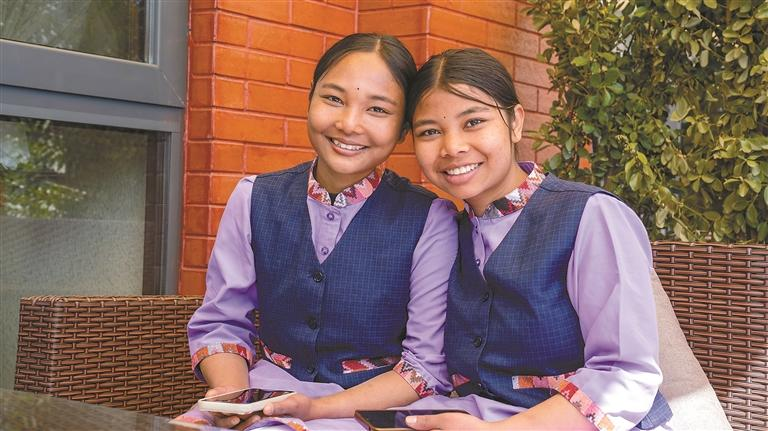
One is 22, the other 20. They came to Lhasa, XizangAutonomous Region, China, from Hetauda, Nepal, and it has already been eight months. The first time we met them, the first thing we noticed was the laughter hiding in their eyes, and the tattoos on their fingers — three English letters: m-o-m. "Hold out your hand," the sisters said, "and Mama is right there."
Inside the Nepali Kitchen, a music restaurant on the banks of the Lhasa Kyichu River, Nepali songs play softly. The sisters get up early, pull on loose jeans, part their hair in the middle, and smooth it back in front of the mirror, revealing their clean foreheads. They prefer loose clothing — when they walk, it catches the wind, carrying a certain boldness.
Setting Out: To See a Different World
Nisa and Tanisa didn't study much. They dropped out after middle school.
After leaving school, the sisters worked at a small eatery back home — washing dishes, carrying plates, making food. Life was like a millstone, turning round and round. But a young person's heart always turns faster than a millstone. That quiet restlessness deep inside was like a flame in a stove — pressed down, but always flickering upward.
It so happened that their uncle knew a Lhasa restaurant owner who was recruiting workers in Nepal and asked if they'd like to go.
They didn't think twice. Just like that, two girls who had never set foot outside Nepal arrived in Lhasa, full of spirit.
There are six people in Nisa and Tanisa's family. Their father drives a truck, their mother works in a restaurant, their eldest brother is a mechanic in Dubai, and their second brother is a thangka painter. Life is neither rich nor poor. The sisters came out simply to see what the other world looked like — the one they'd seen on social media.
When they arrived in Lhasa, the sky was impossibly blue, the clouds floated low — not unlike home. But that resemblance sometimes tugged at them all the more, making them think of Mama.
The restaurant where they work provides room and board. Together, the two earn over 6,000 yuan a month. They keep 1,000 yuan for pocket money and send every remaining penny back home to Nepal.
As we talk, the restaurant fills with customers. The sisters hurry into the kitchen, carefully put on masks, wash their hands, and tie on aprons.
Tanisa's knife falls swift and sure — onions, potatoes, and greens on the cutting board are chopped neatly. She's making Dal Bhat, the signature Nepali dish: steamed rice, lentil soup, and vegetables, mixed with onion, ginger, and garlic — hearty and delicious. Without missing a beat, she moves on to make Sel Roti — rice-batter doughnuts, fried until crispy on the outside and soft within, golden and warm.
Nisa stands at the service window. As soon as a dish is ready, she picks up the plate and walks briskly to the customer's table — a plate of Dal Bhat, a portion of Sel Roti, served with yogurt. Simply perfect.
"We want to make Nepali food even more authentic, so more friends in Lhasa can taste it." Tanisa pauses, then adds: "When you cook with heart, maybe that's how a person gets closer to a city."
Settling In: Living Together with This City
Young people always adapt to new places quickly — but the first real hurdle was language.
In those early days, language barriers led to plenty of funny moments. A customer wanted a bowl and spoon; they gestured for ages but couldn't make themselves understood, so they had to go through the manager.
Both sides were flustered, both were helpless. They'd gesture, and when gesturing failed, they'd look down at their phones, tap open a translation app, wait for the words to appear, and then show the screen. Back and forth — but the job got done.
There was a Tibetan girl working at the restaurant, from Yushu, Qinghai, named Tsering Qiuzang — straightforward, cheerful, and full of questions. The three of them were close in age and soon became close friends.
The sisters learned Mandarin and Tibetan from her, memorizing one word at a time: "nǐ hǎo," "xièxiè," "zài lái" — starting with the simplest. Now, although they still sometimes need the phone to translate, they're no longer strangers.
"Once language clicked, people clicked." In the gaps between kitchen rushes, the three girls would dance on the restaurant's stage. Guozhuang, Nepali dance, hip-hop — when the music hit, they moved.
Living under the same roof, coming from different countries and different ethnic groups, they were endlessly curious about each other. Tsering Qiuzang, being direct, said: "You're right here in person — I have to ask: why do Nepali people eat with their hands? And how do you offer a khata?"
Everything became concrete and warm in the back-and-forth of conversation.
The girls also loved experimenting with beauty. Following a Nepali recipe, the sisters would smash ginger, boil it down, mix the juice with honey, and spread the paste on their faces as a mask — cool and tingling. Tsering Qiuzang shared her own Tibetan face mask with them. The three girls, faces painted yellow or milky white, laughed until they couldn't breathe.
On April 14, it was Tanisa's birthday. Everyone secretly prepared an hour and a half early, gathered around her singing happy birthday, and offered a khata. Tsering Qiuzang gave her a gift set — a cup and lipstick, all the things a girl loves.
Nisa and Tanisa gradually became part of this city — living together with it. When a city accepts you, your life takes root. And with roots, your heart can hold more — like love, like that dream of the future, just within reach.
Looking Ahead: Opening Their OwnRestaurant
Eight months is neither long nor short — but just long enough to quietly fall in love with a city.
The sisters' greatest pleasure is sightseeing. They start work at 9:30 a.m., so they ride their electric scooter from their rental flat, snapping photos all the way. The Potala Palace, the Lhasa River — all captured on their phones and sent in a burst to their mother back in Nepal, and to their respective boyfriends.
When the photos went out, homesickness would surge up — but so would their growing fondness for this place. The two feelings often tangled together.
During video calls home, they'd pull Tsering Qiuzang into the frame and introduce her to the family. Tanisa held up her phone, pointing at her boyfriend's long beard in the video and teasing: "A man with a beard is handsome." On her wrist she wore a bracelet engraved with his name.
Nisa's boyfriend is a chef, and the two are very close. Even when there was nothing to say on a video call, they were happy to just leave it on, watching each other go about their day. Before coming to Lhasa, Nisa had already met her boyfriend's mother, but he had to leave early for work in Dubai, and the two never got to meet. "When we both go back to Nepal, we'll get married," Nisa said.
With that dream in mind, they work even harder. According to their agreement with the boss, they still have four years and four months left in Lhasa.
As for the future, the sisters want to go back to Nepal, buy a two-wheeled electric scooter, and open a little restaurant of their own. Then, in unison, they both laughed again: "But we also want to come back and stay in Lhasa."
"I miss home, but I truly love it here." Nisa said she loves the scenery here, and she's fallen for hot pot. She wants to walk every street and alley in Lhasa, see all four seasons, taste all the good food, and remember it all. The wish to leave and the wish to stay are tangled together — she can't say which one weighs more.
Now, they already think of Lhasa as their second home. Here, there are hopes they can see and touch, people and things they can't bear to leave. When they walk the streets, no one treats them as passersby — everywhere they meet ordinary kindness that settles the heart.
In the evening, the wind blows in from the Kyichu River. The old Nepali songs still loop inside the restaurant. The sisters are clearing dishes, humming softly.
Someone pushes open the restaurant door. They look up — and there are two smiling faces again.
Source: Xizang Daily
Translator: Peng Qing, Liu Fang
Reviewer: Hu Rongguo, Drakpa Wangchen
Copyright © Xizang Daily & China Xizang News All rights reserved
Reproduction in whole or in part without permissions prohibited
Index Code: 藏 ICP 备 05000021 号
Producer: Xizang Daily International Communication Center