





Source:China Daily 2026-07-31
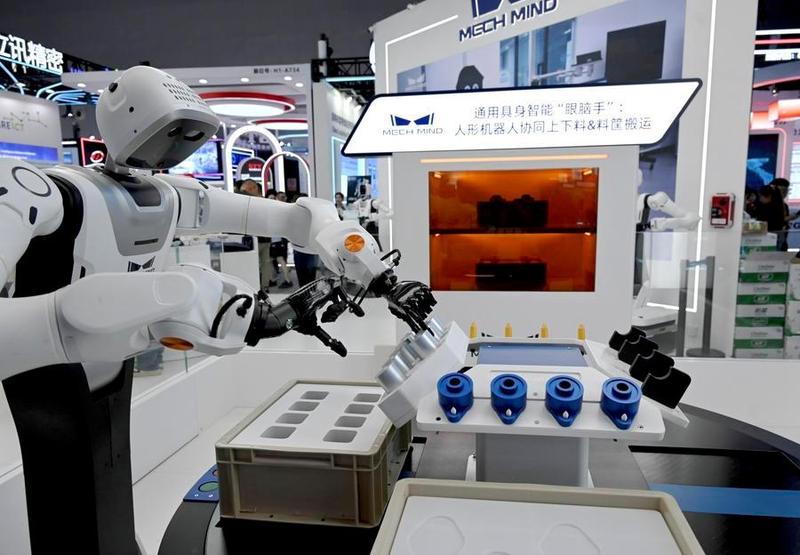 A robot demonstrates precision operation during the 2026 World AI Conference in Shanghai, East China, July 19, 2026. [Photo/Xinhua]
International cooperation is crucial for the development of artificial intelligence, said Evgeny Burnaev, a Russian AI expert and laureate of the Russian government's award in science and technology.
Burnaev, who also served as the director of the artificial intelligence center at the Skolkovo Institute of Science and Technology in Russia, noted that cooperation was the core theme of this year's World Artificial Intelligence Conference, which was held in Shanghai recently.
He explained that AI is a complex discipline that has evolved from isolated research fields into an essential "infrastructure" covering healthcare, production, logistics and climate monitoring. Building a mature AI infrastructure is impossible without international cooperation, as the technology relies heavily on massive data and immense computing power, which require multiparty collaboration.
Regarding the inclusive development of AI, Burnaev warned that existing AI technologies could greatly magnify current global development gaps. To prevent a single culture or value system from dominating, he proposed two key measures: countries should collaborate in basic education and scientific research, and the world must establish unified global benchmarks and technical standards in AI engineering to prevent operational failures across critical systems.
Burnaev's call for inclusivity resonates strongly with China's ongoing efforts. As a major AI power, China has always been an active advocate and practitioner of global AI governance, committed to ensuring that the achievements of intelligent technology benefit people of all countries more equitably.
"China will adhere to coordinating development and security, actively practice multilateralism, uphold the concept of 'people-centric and AI for good', and promote AI to always develop in a beneficial, safe and fair direction," said Zhou Haibing, deputy head of the National Development and Reform Commission.
This commitment has gained international recognition. The British journal Nature previously published an article noting that "China is leading global AI governance" and called on other nations to participate in addressing the common challenges brought by AI-related development.
China's push for global cooperation and governance is backed by its robust and rapidly growing AI ecosystem. Official data show that the country is home to over 6,000 AI enterprises, with the core AI industry scale expected to exceed 1.2 trillion yuan ($177.48 billion) this year, up nearly 30 percent year-on-year.
Furthermore, China is now the world's largest holder of AI patents, and its domestic open-source large models have surpassed 10 billion cumulative downloads globally.
The consumer market is also experiencing a continuous surge in new AI products. In 2025, annual shipments of smart terminals such as AI smartphones and AI computers in China exceeded 100 million units. With significant growth expected to continue this year, sales of AI phones and PCs are projected to surpass those of non-AI products for the first time.
The vitality of this industry was on full display at the conference, where Burnaev highlighted the abundance of smart robots. He identified embodied AI as the core track for the next stage of AI, noting that the emergence of various robot vision-language-action models and motion control models can significantly enhance industrial automation efficiency and handle operations in high-risk scenarios.
"The conference exhibited multiple types of robots and supporting models. The technological trends in this area are highly worthy of attention, and I have seen a large number of eye-catching technological achievements," Burnaev added.
Copyright © Xizang Daily & China Xizang News All rights reserved
Reproduction in whole or in part without permissions prohibited
Index Code: 藏 ICP 备 05000021 号
Producer: Xizang Daily International Communication Center