





Source:xzxw.com 2026-08-12
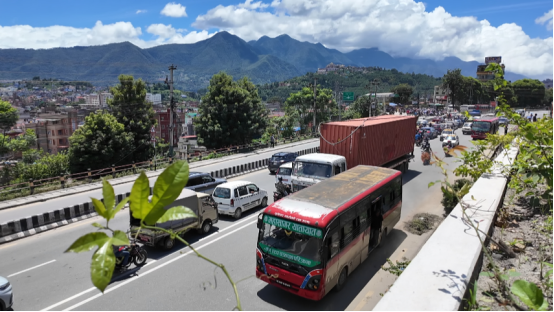
A scene captured by a photographer from the Xizang Daily delegation visiting Nepal, showing vehicles moving in an orderly manner on the widened road section of the China-aided Kathmandu Ring Road congestion improvement project (Phase I). Photo by Kangzhuo
At half past six on a midsummer morning in Nepal's capital Kathmandu, the first rays of sunlight had just laid a soft glow over the road surface when shops along the Ring Road began opening their doors one after another. Before long, traffic and pedestrians swelled — commuters in cars, parents taking children to school, all crisscrossing the thoroughfare, filling the street with a vibrant, bustling energy.
This Ring Road, first built with Chinese assistance, has served as the vital artery sustaining Kathmandu's urban functions for decades. However, as the city's population surged and the number of motor vehicles multiplied, the road's capacity gradually fell short of the people's daily needs. Congestion, localized flooding, and surface wear became nagging troubles for residents along the route. In January 2019, the China-aided Kathmandu Ring Road congestion improvement project (Phase I) was officially handed over. The upgraded road has completely resolved these issues — no more bumps from sunken patches, no more wisps of dust kicked up by passing vehicles. This trunk road slicing through the city's core took over two years to renovate, and today it stands as the most reliable lifeline for nearly 100,000 residents along its corridor, embodying the most down-to-earth details of the enduring China-Nepal cooperation in people's livelihoods.
To get to the bottom of the cooperative logic behind the upgraded Ring Road, the joint reporting team from Xizang Daily and Nepal's Kantipur Media Group made a special visit to the offices of Nepal's Department of Roads under the Ministry of Physical Infrastructure and Transport. In the office of Gopal Prasad Hakhurel, chief of the Road Division, we found the most solid answers. With years of road management experience, Gopal has seen too many foreign projects that pack up and leave as soon as construction is done. But China's aid projects showed him a completely different approach to cooperation: "The international cooperation model demonstrated by this project is not merely about carrying out engineering construction. Chinese technology and Chinese management have deeply influenced the Nepali enterprises that jointly implemented the project. They learned through cooperation, made progress through cooperation, and gradually grew into enterprises capable of independently undertaking more difficult infrastructure projects. So this cooperation model is very good."
During the two-year construction period, the Chinese team did not simply finish the work and leave. Instead, they took local engineers along through every step of the process — from adjusting the asphalt mix formula to suit the local climate, to laying out an expanded drainage network, to the layered reinforcement of high-load-bearing roadbeds — passing on their experience hands-on at every stage. Many of the young Nepali engineers who assisted at the time can now independently lead road maintenance and upgrade projects in surrounding towns and villages. This "working together" model has long become a benchmark spoken of with admiration throughout the local industry.
Leaving the Road Department office, the joint reporting team visited shop owners along the Ring Road. "When the Ring Road was first built, it was the smoothest road in the whole city. We were all so happy," said Bishnu Dahar, who has run a grocery store by the roadside for over 20 years, opening up to the team's cameras. Later, as traffic grew heavier and summer rainstorms came without warning, some old drainage outlets could not discharge water fast enough, causing temporary flooding on certain sections. During rush hour, buses would occasionally get stuck for over ten minutes without moving an inch. Parents taking children to school had to carefully steer the little ones around puddles; on clear days, a passing truck would kick up dust that hung in the air for a while. The road had gradually lost its former smoothness. He watched the road age from new, and then watched it be upgraded.
Walking along the Ring Road, we came across Madhu Kumar Basnet, an engineer from Nepal's Road Department, inspecting the road with his workers during routine maintenance. He had followed the renovation and subsequent upkeep almost from start to finish. With beads of sweat from the summer heat still on his forehead and a fresh smear of asphalt on his trousers, he spoke with intimate knowledge of the road's transformation before the camera: "Our maintenance is divided into daily upkeep and regular major overhauls. Daily maintenance means ten-hour shifts every day; major overhauls happen once every five years, with the most recent two years ago. Now the living environment in this area has become much better, and everyone is very satisfied." Pointing to the neatly built drainage inlets by the roadside, he noted that last summer, when Kathmandu saw days of heavy rain, not a single section of the Ring Road experienced significant flooding, and residents' courtyards along the route were never inundated again.
Today, the Ring Road's drains flow freely, shade trees line the curbs, and cars, buses, and motorcycles move in orderly fashion under the midsummer sun. Parents and children walk steadily along the sidewalks, and the entire street exudes a simple, down-to-earth vitality.
Throughout the coverage, the journalists from both countries strolled slowly along the tree-shaded Ring Road, squatting by grocery store entrances to chat with shopkeepers about the changes in commuting over the years, standing at bus stops to talk with waiting office workers about their new travel experiences, and capturing candid moments of passersby smiling as they wiped sweat on the brand-new road. This new road, bathed in Kathmandu's midsummer light, is the culmination of decades of continuous China-Nepal infrastructure cooperation. It needs no grand, impassioned rhetoric; it quietly embeds the weight of the China-Nepal community with a shared future into everyone's busy daily lives, bringing the warmth that crosses the Himalayas truly and tangibly to the hearts of the people.
Xizang Daily reporters: Liu Fang, Zhang Xiaoming, Drakpa Wangchen, Jia Dan, Kangzhuo
The Kathmandu Postreporter: Arjun Poudel
English writing: Liu Fang
Copyright © Xizang Daily & China Xizang News All rights reserved
Reproduction in whole or in part without permissions prohibited
Index Code: 藏 ICP 备 05000021 号
Producer: Xizang Daily International Communication Center