





Source:xzxw.com 2026-08-13
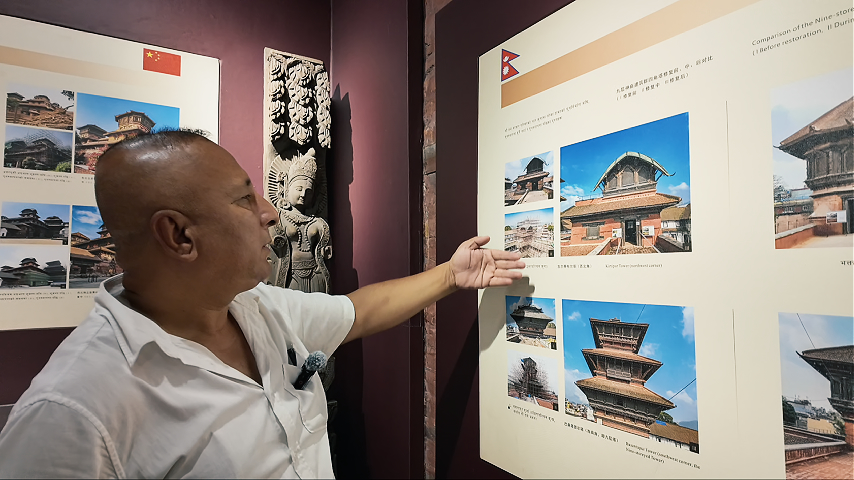
Sunil Dongol, a photographer at the Hanumandhoka Durbar Museum, is briefing visitors on the Chinese government‑aided restoration project of the Nine‑Storeyed Basantapur Tower at Kathmandu's Durbar Square. Photo by Kang Zhuo.
The Nine-Storeyed Temple, also known as Basantapur Tower, is a vital part of the Hanumandhoka Palace in Nepal. In 1979, it was inscribed on the UNESCO World Heritage List as a core component of the Kathmandu Valley.
On April 25, 2015, a devastating 8.1-magnitude earthquake struck Nepal. The architectural treasure, dating back to the 17th century, sustained extensive damage. The entire palace complex was heavily affected; the top three floors of the originally 32-meter-high Nine-Storeyed Temple completely collapsed, leaving broken masonry and structural fragments strewn across the site.
In response to Nepal's request for assistance, the Chinese and Nepalese governments agreed to launch the restoration project for the Nine-Storeyed Temple. From its official start in August 2017 to its final acceptance inspection at the end of 2024, the Chinese government-aided restoration project of the Nine-Storeyed Basantapur Tower at Kathmandu's Durbar Square won high praise from Nepalese experts for its exemplary restoration quality.
In July 2026, journalists from Xizang Daily, together with Arjun Bhandari, a journalist from Nepal's The Kathmandu Post, visited the restored Nine-Storeyed Temple complex to see for themselves the historic treasure restored to its former glory.
It was mid-afternoon, and a steady flow of international tourists and local residents were visiting the site. In the west side hall of Luohan Yard, a permanent exhibition on China's aid project for the restoration of the Nine-Storeyed Temple is on display. A series of photographs vividly capture the immense destruction wrought by the earthquake on the palace complex, alongside scenes of Chinese and Nepalese cultural heritage professionals working side by side on the restoration.
Sunil Dongol, a photographer with the Hanumandhoka Durbar Museum, said he had been working there for nearly seven years and was present on site throughout the restoration. "The Chinese team did a remarkable job," he said, pointing to a wooden carving. "Their management was sound, the workmanship was solid, and every detail was carefully handled. Take this small statue, for example — the decorative ribbon trailing behind the main figure had broken off. The Chinese conservators consulted extensive historical records and restored it following the principle of 'restoring the old as it was.'"
Following in the footsteps of Sunil Dongol, we climbed the narrow wooden staircase and made our way to the temple's highest point — the ninth floor. Restored to its former glory, the roof is adorned with an array of rustic statues and auspicious motifs, while the floorboards feel firm and reassuring underfoot. Tourists paused to raise their phones, capturing the panoramic view of Durbar Square through the intricately carved wooden lattice windows, with the whole scene enveloped in an atmosphere of quiet serenity.
Sandeep Khanal, chief archaeological officer at the Department of Archaeology of Nepal, said in a joint interview that the restoration of the Nine-Storeyed Temple after the earthquake was among the most challenging projects he had encountered. Striking the delicate balance between preserving the building's authentic character and ensuring its structural integrity, he noted, was an extremely complex undertaking. Throughout the process, the Chinese government provided not only technical expertise but also substantial financial support. Now that the project has been successfully completed, he expressed his deep gratitude to the Chinese government on behalf of his agency.
More than 700 years ago, Arniko, the renowned Nepali architect, crossed the Himalayas and led a group of artisans to China, where he presided over the construction of the White Stupa at Miaoying Temple in Beijing. Today, Chinese cultural heritage conservators have made their way to Kathmandu, working hand in hand with Nepalese artisans to carry forward the enduring friendship between the two countries.
A gentle breeze stirs the wind chimes at the eaves, their crisp notes echoing like whispers from the past; crows take flight, tracing long arcs across the blue expanse, as if rippling the very surface of time. The Nine-Storeyed Temple stands in silent witness — reborn from devastation, it now appears more grounded than ever, calmly overlooking the ebb and flow of the square below.
Its return is more than the restoration of a heritage site; it is a solemn handclasp in the great relay of human civilization. From the devastation of the earthquake to today's majestic resurgence, the Chinese aid team and their Nepalese counterparts worked shoulder to shoulder, mending the wounds of the earth with their sweat and awakening a sleeping palace with unwavering dedication. Every beam raised anew carries a deep reverence for history; every intricately carved ornament speaks to a shared conviction in a common future.
Across the Himalayas, the friendship between China and Nepal is renewed and strengthened with each passing day through the vibrant exchange of civilizations.
Xizang Daily reporters: Jia Dan, Zhang Xiaoming, Drakpa Wangchen, Liu Fang, Kang Zhuo
The Kathmandu Post reporter: Arjun Poudel
English writing: Jia Dan
Copyright © Xizang Daily & China Xizang News All rights reserved
Reproduction in whole or in part without permissions prohibited
Index Code: 藏 ICP 备 05000021 号
Producer: Xizang Daily International Communication Center