





Source:xzxw.com 2026-08-13
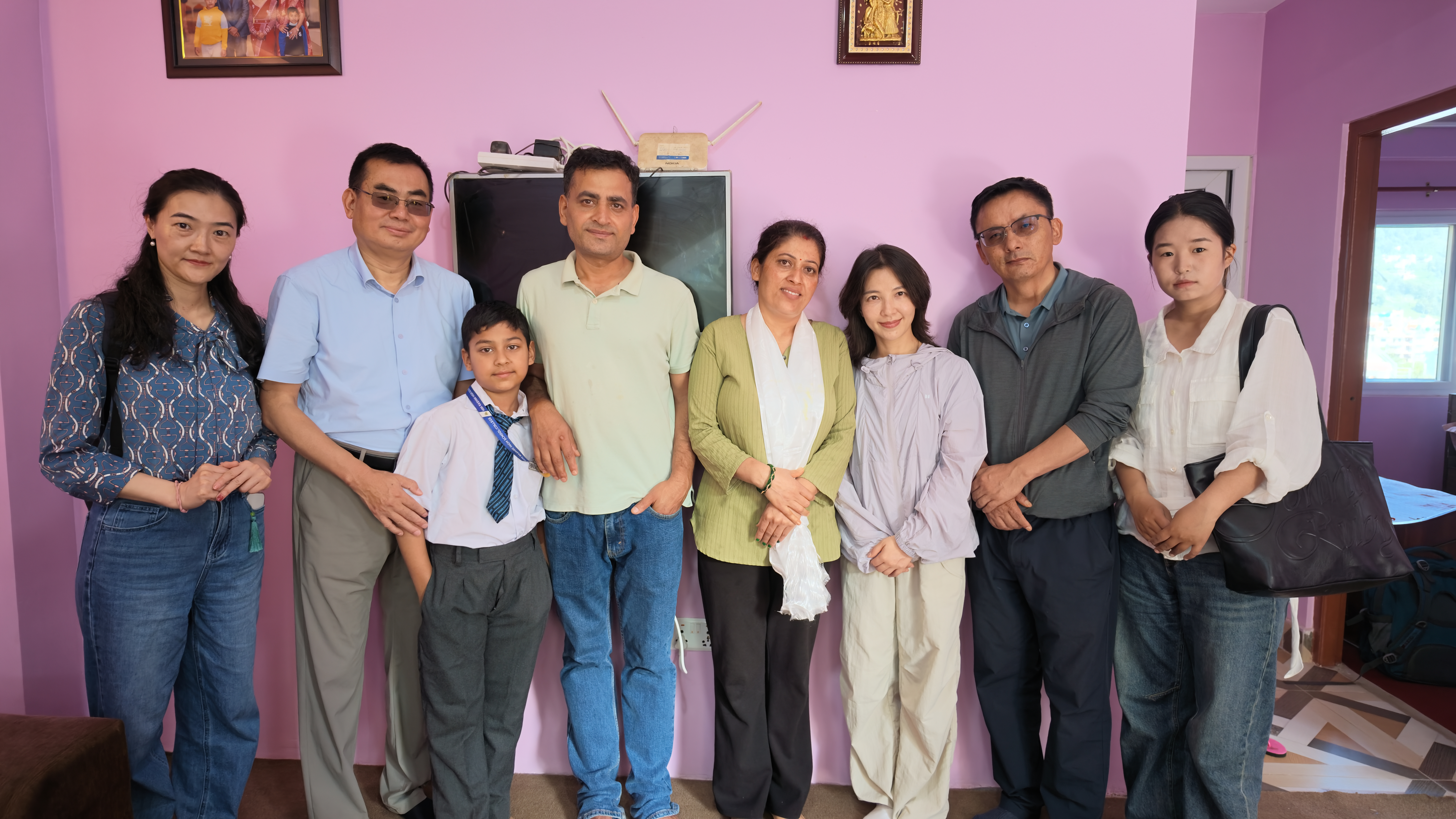
Photo shows reporters from Xizang Daily posing for a group photo with Arjun Poudel (4th from left), a journalist from The Kathmandu Post, and his family. Photo by Kang Zhuo
July in Kathmandu is the height of the monsoon.
Morning on Thamel Street begins with the patter of light footsteps. Walking along the damp cobblestones, tea stalls are already firing up their stoves; white steam mingles with the aroma of spices, rising in wisps against the dawn light. The China Xizang Bookstore sits deep in this street. In late July 2026, we pushed open its door.
A Family's Three Generations of "China Ties"
Mr. Harish Chandra Shah was leaning over, arranging a row of Chinese-language books. Over 70 years old, he wore Nepal's national dress — a Daura-Suruwal suit paired with a Dhaka topi cap — looking sprightly. Hearing footsteps, he turned around, and the wrinkles at the corners of his eyes crinkled into a warm arc.
"Are you from Xizang, China?" he asked, his Mandarin surprisingly standard.
Harish Chandra Shah, chairman of the Nepal-China Cultural and Educational Association, studied in China in 1977, spending seven years at Beijing University of Chinese Medicine. When he spoke of his early days in China, not even knowing how to say "ni hao," he spread his hands in a gesture of helplessness. Recalling the days when he helped farmers harvest wheat in the Beijing countryside and lived on food and cloth coupons, his eyes lit up and a smile tugged at his lips.
"My father visited China in 1963," he said, putting down the book in his hands. "He told me that China is Nepal's most reliable friend." That sentence was like a seed, planted in his heart for decades, and has now grown into a tree — his daughter completed her postgraduate studies at Beijing Medical University, his son studied in China and later joined Huawei, and his brother-in-law also pursued further studies in China. "The four of us in our family speak Chinese at home," he said, with unmistakable pride in his voice.
Zhang Jun, the bookstore manager, brought over several cups of Nepali milk tea. He has lived in Kathmandu for over a decade and opened this bookstore. During the great earthquake of 2015, books were scattered all over the floor, but he didn't have time to tend to them — he locked up and rushed to deliver supplies to the disaster area. When he returned, he looked at the messy bookstore and kept thinking to himself: "I can't close it down." He raised his teacup, saying, "If I close it, where would Nepalis go to read Chinese books?" These books and exhibits are like messengers, connecting the splendid civilization of the snowy plateau on one end, and on the other, the profound friendship of mutual learning and shared support between China and Nepal over millennia.
Harish Chandra Shah took over the conversation: "In Nepal, more and more people now speak Chinese." When he first arrived in China in 1977, only a handful of Nepalis could speak Chinese. Today, almost any shopkeeper on Thamel Street can quote prices in Chinese. From "language connectivity" to "heart-to-heart connectivity," Chinese is spreading to every corner of Kathmandu.
A Temple's Seven-Year "Road to Restoration"
The China-aided restoration project of the nine-story temple is China's first large-scale overseas cultural heritage conservation project in Nepal. Completed in November 2024, the project took seven years of dedicated effort. By reusing 85% of the original structural components, it preserved the site's historical authenticity to the greatest extent possible. The project established a deep cooperative model of "Chinese-led technology and Nepali craftsmanship" — over 10 Chinese resident experts were responsible for overall design coordination and technical oversight, while more than 80 local Nepali artisans carried out the core restoration work using their generations-old woodcarving skills. At the same time, over 10 Chinese "heritage doctors" rotated in shifts, using scientific instruments as stethoscopes to diagnose and treat the thousand-year-old temple. This collaboration was not only a fusion of skills but also a moving testament to the mutual enrichment of two civilizations.
In the office of Nepal's chief archaeologist at the Department of Archaeology, Sandip Khanal opened his phone photo album to show us the before-and-after comparison of the nine-story temple. On April 25, 2015, after the violent earthquake, this Nepali treasure, originally built in the 17th century, had largely collapsed — "rubble everywhere, as if crushed by a giant hand." In the post-restoration photos, the ochre-red brick walls rose anew, and the wooden carvings on the three-tiered eaves glowed with a golden-brown luster in the sunlight.
"I was on site during the tower's renovation," said Sunil Dongol, who has been photographing cultural relics at the Hanuman Dhoka Palace Museum ever since the earthquake. He was full of praise for the Chinese aid workers: "They managed things well, and the construction quality was excellent. The nine-story temple has been restored to what it was before the earthquake."
Walking through Durbar Square, the nine-story temple stands before you. A woman in a sari, holding her child's hand, passed beneath the tower. The child looked up and pointed a little finger toward the wooden eaves that taper upward, layer by layer. The lotus flowers carved into those eaves — petal by petal, chiseled by hand — had shattered on the ground seven years ago. They were picked up and pieced back together by Nepali and Chinese hands, like mending a broken dream.
Now it stands once more on the Kathmandu skyline — quieter than before, and steadier than before.
A Highway, Countless "Bridges to the Heart"
The rain stopped, and the sun came out.
Kathmandu's Ring Road glistened after the heavy downpour, its white lane markings crisp and new, with vehicles flowing smoothly. In the old city just a few steps away, the alleys are narrow, motorbikes and pedestrians jostling for space amid a cacophony of honking horns. The Ring Road cuts through like a blade, cleanly slicing through Kathmandu's congestion.
By the roadside, workers were performing routine road maintenance. One maintenance worker named Bahadur put down his wrench and greeted us. He has worked on the Ring Road for three years. "Before, delivering goods from over there," he said, pointing toward the vegetable market, "used to take more than an hour in traffic. Now it takes 20 minutes." He gestured with both hands, afraid we wouldn't understand. When he learned that we were Chinese journalists, he gave a thumbs-up with his right hand and grinned: "Chinese road, very good!"
In the 1960s, the China-aided Arniko Highway and Prithvi Highway once opened up the north-south transportation arteries for Nepal. Over the past 60-plus years — from the Arniko Highway to the Kathmandu Ring Road, from the feasibility study of the Gyirong–Kathmandu cross-border railway to the Syalbum–Simikot road project — China has always been a fellow traveler in Nepal's transition from a "landlocked" to a "land-linked" nation. The joint statement issued by China and Nepal at the end of 2024 made clear that both sides will continue to promote Phase IV of the Arniko Highway upkeep project and Phase II of the Ring Road renovation, steadily paving wider roads into Nepal's hinterland.
Arjun Poudel, who joined us in the coverage, scribbled notes rapidly in his notebook. He is a reporter for The Kathmandu Post under Nepal's Kantipur Media Group. "I've always followed China-aided projects in Nepal, and I really want to write about them," he said, looking up. "But many people don't know exactly where these projects are or what they bring to us Nepalis. What I want to write are the human stories."
Gopal Prasad Hakhurel, division chief at the Road Department under Nepal's Ministry of Physical Infrastructure and Transport, is leading the planning of Kathmandu's transportation system. Commenting on China-aided projects in Nepal, he said: "China's assistance does not just build roads and bridges for Nepal; it also adapts to local conditions and simultaneously exports technology and construction techniques. Once a project is completed, the technology stays — that is the sustainable approach." With that, he pointed to the map of Nepal's transport network before him, repeatedly praising this model of cooperation as "very good."
Back at our lodgings late at night. Outside the window, scattered lights stretched out toward the dark mountain silhouettes in the distance. I recalled Harish Chandra Shah's words that afternoon — "Seeing China's development gives me as much joy as if my own country had achieved it." He said it casually, as if it were a matter that needed no elaboration.
Perhaps that is the truest essence of China-Nepal relations. It is not the printed words in joint statements, nor the red silk pulled at ribbon-cutting ceremonies. It is the well-thumbed Chinese book in a bookstore, the thumb-up from Bahadur on the Ring Road, and the upturned corner of the eaves reflected in the eyes of a mother and child as she led her little one past the nine-story temple.
These small, warm moments are like the countless streams on the southern slopes of the Himalayas — silently flowing down and merging into a river called "Friendship."
We just happened to stand by its bank, bent down, cupped a handful in our palms, and noted its temperature.
Xizang Daily reporters: Drakpa Wangchen, Zhang Xiaoming, KangZhuo, Jia Dan, Liu Fang
The Kathmandu Postreporter: Arjun Poudel
English writing: Liu Fang
Copyright © Xizang Daily & China Xizang News All rights reserved
Reproduction in whole or in part without permissions prohibited
Index Code: 藏 ICP 备 05000021 号
Producer: Xizang Daily International Communication Center