



Source:xzxw.com 2026-08-19
Reporters learned on the 16th at the Qingke Industry Scientific and Technological Achievement Observation and Seminar that the Qinghai-Xizang Plateau Crop Germplasm Medium-term Repository in Xizang preserves more than 10,000 Qingke (highland barley) accessions.
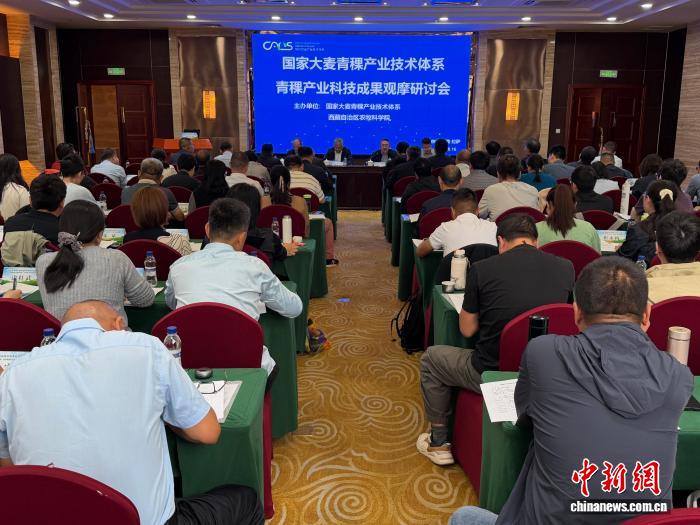
The event was jointly organized by the National Barley and Qingke Industrial Technology System, the Xizang Autonomous Region Qingke Industrial Technology System, the Institute of Crop Sciences of the Chinese Academy of Agricultural Sciences (CAAS), and the Xizang Academy of Agricultural and Animal Husbandry Sciences. It featured four core segments: field achievement observation, thematic seminars on the "15th Five-Year Plan" system work, youth academic exchanges, and supply-demand matching between scientific institutions and enterprises. Integrating achievement display, experience sharing, technological breakthroughs, talent cultivation, and production-marketing linkage, the event provided an important platform for the integrated development of industry, academia, research, and application in the Qingke sector.
According to the conference, the Qinghai-Xizang Plateau Crop Germplasm Medium-term Repository have been established in Xizang, preserving over 10,000 Qingke accessions. A digital archive and QR code traceability system have been put in place to enable standardized management and efficient utilization of these resources. More than 500 elite accessions have been screened, a core collection of 300 accessions and a backbone parental population of 200 accessions have been constructed, providing a solid material foundation for genetic improvement of barley varieties. Characteristic resources such as black and blue highland barley adapted to altitudes above 4,000 meters have been identified, and systematic evaluations have been conducted on traits including disease resistance, cold tolerance, barren tolerance, and high β-glucan content, offering excellent germplasm support for breeding new varieties with superior quality and stress tolerance.
It was also noted that variety upgrading and iteration continue to safeguard food security in Xizang-related regions. In recent years, the National Barley and Qingke Industrial Technology System has steadily promoted the renewal and iteration of highland barley varieties. High-yielding types suited to valley farmland, such as Zangqing 2000 and Zangqing 3000, have achieved per-mu yields exceeding 350 kg. With medium-late maturity, tall sturdy stalks, and lodging resistance, they are suitable for full mechanization and have become the new leading varieties, significantly improving production efficiency and large-scale cultivation in valley agricultural areas. Early-maturing cold-tolerant types like Zangqing 17 and Ximala 23 thrive at high altitudes, with growth periods shortened by 7 to 10 days, adapted to high-altitude cold regions, ensuring stable production and harvest in areas above 4,200 meters. High-quality specialty varieties such as Zangqing 18, rich in β-glucan, empower the deep-processing industry chain of highland barley. Dongqing 18 enables multiple cropping in areas with concurrent rain and heat seasons, greatly enhancing land utilization and overall agricultural benefits.
"During the '15th Five-Year Plan' period, we will work together with the regional industrial technology system team, seek resources from multiple channels, accelerate the research, development and application of new breeding technologies, continue to cultivate new highland barley varieties with high quality, high yield, and green (environmentally friendly) and disease-resistantneeded to support industrial high-quality development, and strengthen the integrated demonstration and promotion of new varieties and technologies to address new challenges posed by climate change on the plateau," said Professor Guo Ganggang, deputy director of the Institute of Crop Sciences, CAAS, and Chief Scientist of the National Barley and Qingke Industrial Technology System.
It is learned that this conference brought together industry experts, industrial backbone personnel, and young talents, creating an efficient platform for communicating and joint development. It charted the direction and consolidated collective strength for scientific and technological innovation and industry-research integration in the highland barley sector.
Reporter: Zhao Lang
Translator: Ni Weijing
First Review: Zhi Xinghua
Second Review: Li Chengye
Third Review: Hu Rongguo
Copyright © Xizang Daily & China Xizang News All rights reserved
Reproduction in whole or in part without permissions prohibited
Index Code: 藏 ICP 备 05000021 号
Producer: Xizang Daily International Communication Center