





Source:xzxw.com 2026-08-21
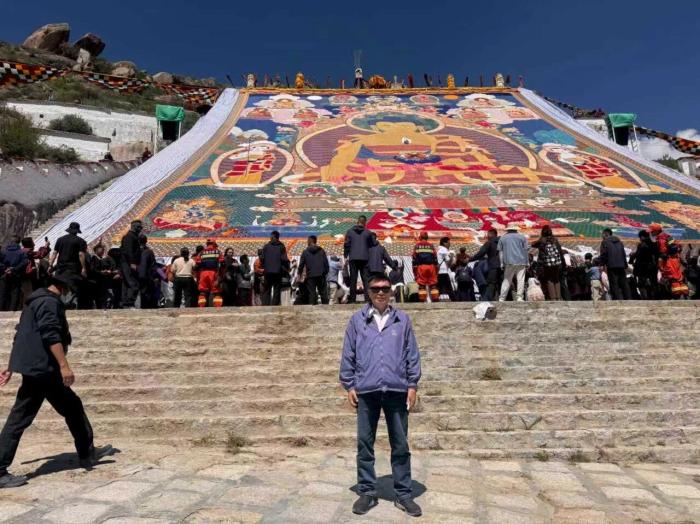
In early August, Professor Yuan Juzheng from National Taiwan University was wearing a long-sleeved shirt, basking in the warm sunshine of Lhasa, despite the early morning chill. During a live link-up on a Taiwanese talk show, he excitedly shared what he had seen with his own eyes in Xizang.
Lhasa, at an altitude of 3650 meters,roughly the height of Taiwan's Yushan (Jade Mountain),makes you short of breath if you speak too fast.
But Yuan said it was "the most worthwhile place I have ever visited in my life".
After arriving in Lhasa, Yuan plunged straight into the Xizang Museum and spent an entire day there. What did he see?
In 1244, the Sakya Buddhist master Sakya Pandita Kunga Gyeltsen and his nephew Phagpa traveled to Liangzhou and held the historically significant "Liangzhou Meeting" with Kuo Duan, a grandson of Genghis Khan, in what is now Wuwei City, Gansu Province. From that time on, Xizang was formally brought under the administrative jurisdiction of the central government.
He also mentioned the Tang–Tubo Alliance Stele, erected in 823 AD, which stands in front of the Jokhang Temple in Lhasa and is inscribed in both Chinese and Tibetan scripts.
The original stele is still there, its characters weathered, but the museum has a clear replica. That stele has stood there for over a thousand years, through wind and rain, and has never been toppled.
"History is right there," said Yuan. "Xizang has been an inseparable part of China since ancient times and the sovereignty is complete and indivisible."
During the live link-up, Yuan also cited two sets of figures.
Under the old serfdom system in Xizang, the average life expectancy was only 35.5 years. Today, the average life expectancy in the Xizang Autonomous Region is 72.5 years – double that figure.
"No one doesn't want to live," he said. "Just by this one metric, you can see what kind of change has taken place in Xizang."
Xizang Autonomous Region has achieved nine years of compulsory education and 15 years of free education, from preschool through high school, "as long as you are willing to study, there is no financial problem." "Education gives people the ability to make free choices," Yuan remarked.
In Lhasa, Yuan met a local Tibetan tour guide, who openly admitted that he was a descendant of serfs from old Xizang.
"The guide said that back then, no one dared to leave the serf-owner they were attached to. It reminded me of those enslaved Black people in the American South who were afraid to leave the plantations."
But now? That guide, dressed in modern clothes and speaking fluent Mandarin, explained the history to Yuan. The development of education and society in Xizang has given ordinary Tibetan compatriots more choices in how they live their lives.
Yuan also visited the Potala Palace, Norbulingka, and other sites.
"Doesn't the West say Xizang has 'cultural genocide' and 'religious persecution'?" Yuan asked. "Then who are those people prostrating themselves every three steps? Who is maintaining those well-preserved palaces?"
If Barkhor Street represents the old Xizang, then the "modern young women" on the streets represent the new Xizang.
"The women here have high noses, big eyes, and oval faces, with sunglasses on, they are incredibly beautiful," Yuan described.
In the morning, they drink Italian coffee, eat French croissants, and use Wi-Fi to do live broadcasts...
"The Xizang that the outside world imagines as 'backward and full of yaks' is no longer like that," Yuan emphasized repeatedly.
What moved Yuan most during the live link-up was a Tibetan friend who runs an English cram school in Lhasa, Xizang. The two had dinner and chatted, and the conversation turned to the Taiwanese film Warriors of the Rainbow: Seediq Bale---an epic about Taiwan's indigenous people resisting Japanese colonial rule.
Yuan was taken aback: "He not only learns Chinese, but also English. He watches Taiwanese films and talks with me about freedom and dignity. And you tell me this person is being 'oppressed'?"
"Those anti-China forces use smears against Xizang to annoy China, they just can't stand to see China do well!" "You can't on one hand declare the Universal Declaration of Human Rights at the UN, and on the other hand allow a serfdom system to persist in Xizang." "Today's Xizang is direct proof of breaking through the international discourse hegemony," Yuan said with growing excitement.
"Xizang is standing in the future waiting for us, not lagging behind."
Reporter: Zhu Yanjing
Translator: Ni Weijing
First Review: Zhi Xinghua
Second Review: Li Chengye
Third Review: Hu Rongguo
Copyright © Xizang Daily & China Xizang News All rights reserved
Reproduction in whole or in part without permissions prohibited
Index Code: 藏 ICP 备 05000021 号
Producer: Xizang Daily International Communication Center