





Source:xzxw.com 2026-08-21
A gentle breeze swept across the Qiangtang grassland in the afternoon. Vast expanses of photovoltaic panels stretched across the wide pasture, while herds of yaks leisurely roamed beneath them, grazing on fresh grass. The crisp tinkling of bells mingled with the soft hum of equipment.
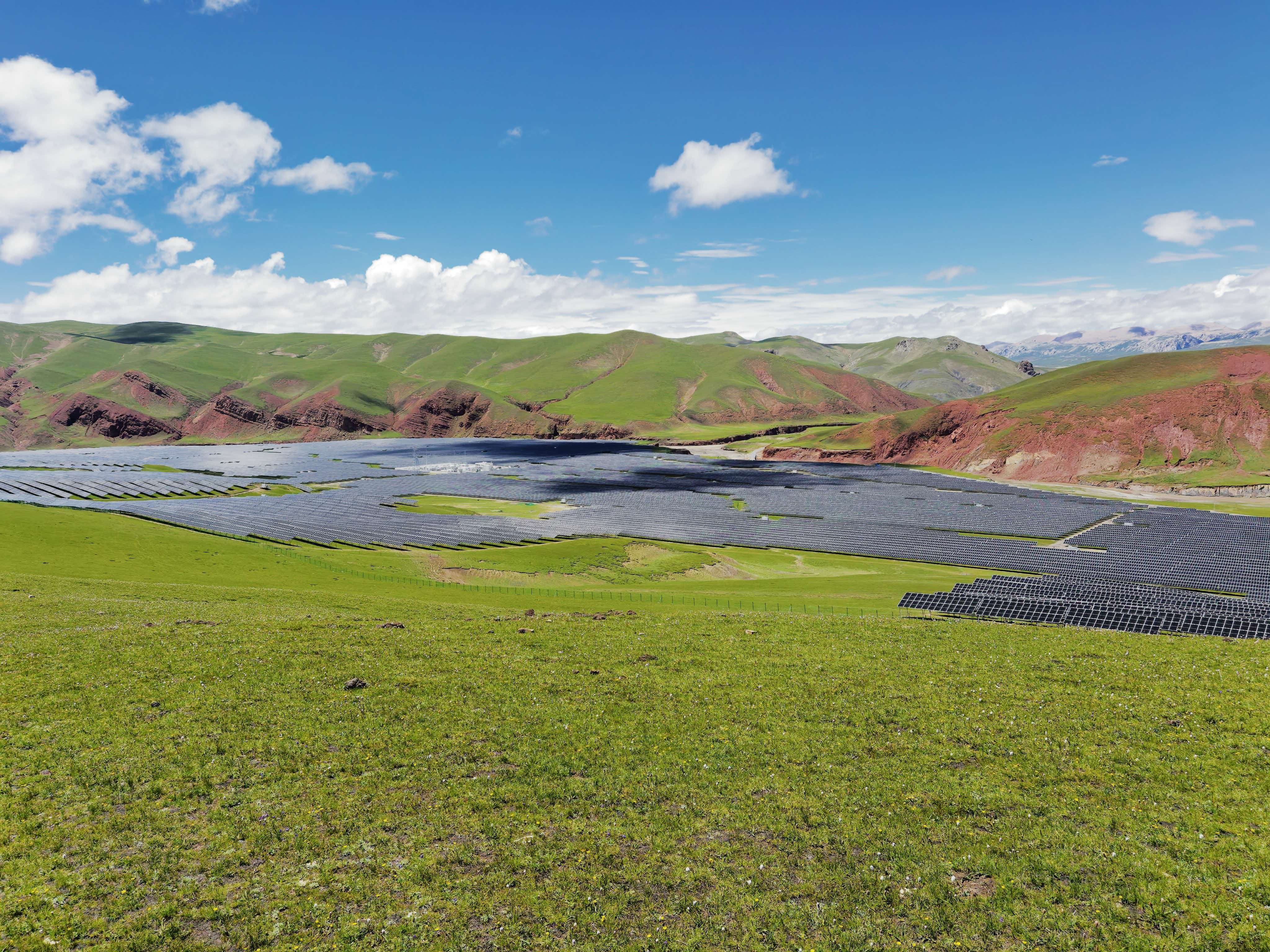
At the State Power Investment Corporation's Botuo 150 MW solar-plus-storage power station in Xiaqu Town, Biru County, Nagqu City, Xizang Autonomous Rregion, the panels above harvest sunlight and store energy, while the pasture below thrives with cattle and sheep – a new pastoral scenery where ecological conservation and industrial income growth coexist in harmony.
Since the start of the “14th Five-Year Plan” period, Xizang has vigorously developed clean energy and promoted the integrated development of "photovoltaics + animal husbandry", turning the plateau's abundant sunshine into both electricity for thousands of homes and warm incomes for herders. This solar-storage power station, perched at an altitude of 4400 meters in Biru County, stands as a vivid example of this development path.
The station was built in two phases. Phase I was connected to the grid in early 2024, and Phase II followed in early 2025, covering a total area of over 3100 mu (about 207 hectares). Harsh winds, frigid temperatures, and intense ultraviolet radiation are year-round challenges here, yet the innovative "pastoral-PV" complementary model has dispelled residents' initial concerns, allowing grassland and green power to flourish together.
"When the project was first planned and land requisition began, involving the pastures of the Botuo community, many villagers were worried that the construction would damage their livelihood. At first, there was considerable resistance." recalled Losang Jiezan, a shift operator on duty, still vividly remembering the early days.
But as the project progressed, villagers saw firsthand that the construction fully protected the original terrain and vegetation. The 1.8-meter-high PV supports left ample room for grazing, and the fences were specially fitted with multiple passages so that cattle and sheep could move freely without restriction. Gradually, the doubts faded.
What delighted the herders even more was that the PV panels blocked the harsh sun, greatly reducing soil moisture evaporation and making the grass grow even more luxuriantly. In winter, when herders move their livestock here, hundreds of cattle and sheep find food and shelter – power generation and livestock raising coexist without disturbance, and since operations began, there has never been any case of animals damaging the equipment.
The project's first tangible benefit was real employment opportunities. During construction, local villagers were given hiring priority, providing a vital source of short-term income for the pastoral community. Wages paid to local workers across both phases exceeded 11.2 million yuan, allowing many herders to earn income close to home. After the construction boom subsided, stable long-term positions remained in the village. Mengjia, a herder from the Botuo community, was among the first locals to secure regular employment at the SPIC Biru Botuo 150 MW station. Since joining during Phase I, he has worked as a full-time driver for the plant, leaving behind a life solely dependent on herding and now earning a steady monthly salary of over 6000 yuan. "Before, I spent all my days tending livestock; now I have a fixed monthly income, and life feels much more secure," Mengjia said happily.
Beyond labor income, pastureland shareholding dividends have become a long-term source of community revenue. Under a five-year dividend cycle, the 150 MW site is expected to distribute 8.6 million yuan in dividends, with per capita dividends for community residents approaching 10,000 yuan – a clear demonstration of green resources being steadily transformed into herders' "money bags" .
From the plant site, rows of photovoltaic panels ceaselessly capture the plateau's sunlight and convert it into clean energy. Zhang Jianxun, the station's manager, explained the entire power generation process in detail: "The PV panels collect solar energy and generate direct current, which is converted to alternating current by inverters. After the voltage is boosted by box-type transformers, the power is sent to the step-up substation for another voltage increase, and finally fed into the public grid via two transmission lines."
Since coming online, this integrated system has accumulated a total generation of 192 million kWh. This steady flow of green electricity has saved 57,600 tons of standard coal and reduced carbon dioxide emissions by 150,000 tons, contributing strong momentum to the plateau's low-carbon ecological development.
Reporter: Chodron
Translator: Ni Weijing
First Review: Zhi Xinghua
Second Review: Li Chengye
Third Review: Hu Rongguo
Copyright © Xizang Daily & China Xizang News All rights reserved
Reproduction in whole or in part without permissions prohibited
Index Code: 藏 ICP 备 05000021 号
Producer: Xizang Daily International Communication Center