





Source:xzxw.com 2026-09-21
Located in Se Town, Lhozhag County, Shannan City, Tsoyu Village has seen its tourism revenue grow from just over 100,000 yuan per year to 15 million yuan over more than a decade, with per capita annual income reaching 35,000 yuan and nearly 1,500 tourists received daily during peak season.
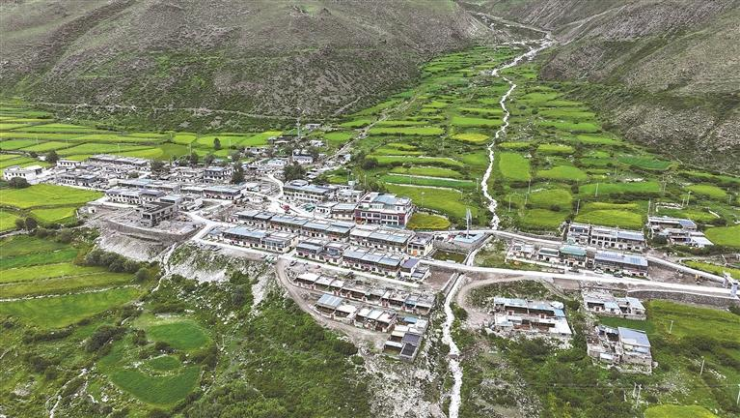
Tsoyu Village at the foot of Mount Kula Gangri (drone photo). [Photo/Xue Ying]
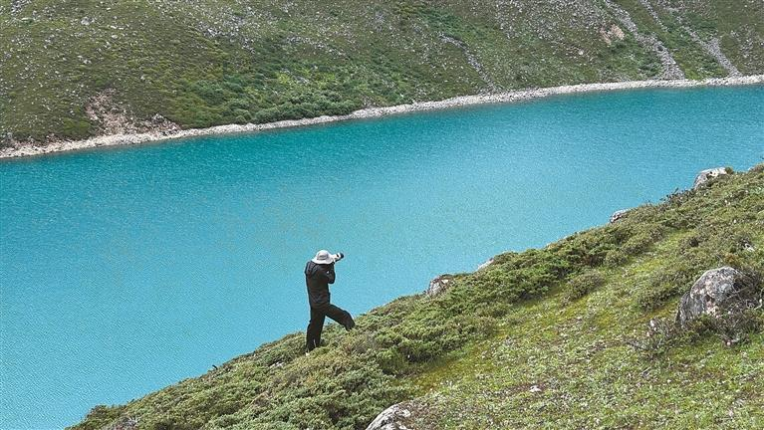
Padmaling Lakephotographedby tourists.[Photo/Wu Peitao]
At noon, Penpa Tsering folded the last bath towel and placed it in the guest room cabinet. Seven guest rooms, he checked the switches for the air conditioner, oxygen generator, and heating one by one,straightened the signage and mopped the floor until it shone like a mirror. Having done all this, he went downstairs and got himself a bowl of plain tea.
It took Penpa Tsering a long time to get used to not having to commute early in the morning. Now 33 years old, Penpa Tsering had previously worked as a migrant laborer elsewhere. Last year he quit his job, returned to the village, and together with his family runs this guesthouse, while also serving as the village doctor. "The children are no longer left-behind children, and the elderly can be cared for too."
Penpa Tsering's home is located in Se Township, Lhozhag County, Shannan City—a small village with a beautiful name: Tsoyu Village, which means "home of the lake" in Tibetan. Mount Kula Gangri, at 7,538 meters above sea level, towers into the clouds, while Pagsum Lake, Jeku Lake, and Zhegong Sum Lake are strung like turquoise in the valley, becoming an endless treasure for the villagers of Tsoyu at the foot of the mountain.
Over more than a decade, Tsoyu Village's tourism revenue has soared from just over 100,000 yuan per year to 15 million yuan, with per capita annual income reaching 35,000 yuan and nearly 1,500 tourists received daily during peak season.
Living off the mountain and living off the waterbut how to do so, Tsoyu Village has gone about it somewhat differently.
In 2019, the village secured policy funding to build hiking boardwalks, viewing platforms, rest pavilions, and other facilities along three traditional herding trails. The construction company initially designed the path to be 3 meters wide, but the village did not agree.
"Too wide—the impact on the ecology would be too severe," said Gama Gyurmey, director of the village committee. After several rounds of negotiation, the path width was finally set at 80 centimeters, just enough for two people to pass sideways. Moreover, during construction, no excavators or other machinery were used—cement and steel were all carried into the valley by villagers on their backs or by pack animals.
Walking through the scenic area, aside from the most basic facilities, there are no other decorations. There are no blue-and-whiteviral signposts saying "I miss you so much at Pagsum Lake," and no viral snacks like "giant fried squid" or "bamboo tube milk tea" to be bought. "There are too many homogenized, commercialized tourism gimmicks out there—we don't want that," said Gama Gyurmey.
Not only that, but Tsoyu Village seems to be deliberately "putting on the brakes" when it comes to making money. When there are too many people, visitor caps are implemented—rather than letting the meadows and lakes get "exhausted," they would rather make tourists wait a bit at the entrance.
"The mountain won't walk away, the lake won't run off—what's the hurry?" Gama Gyurmey's words were calm yet powerful.
Perhaps it is precisely this unhurried spirit that has made Tsoyu Village so popular.
On one wall of the village committee office, banners given by grateful tourists hang everywhere. It turns out that for a long time, Tsoyu Village served as a free supply station for hiking enthusiasts. A mouthful of delicious tsampa, a bowl of steaming butter tea—these comforted many passing hikers. "Villagers occasionally serve as guides and earn a little pocket money," Gama Gyurmey explained. Because they know the terrain well, the village also organized a rescue team to assist those in danger, free of charge.
Word of mouth accumulated bit by bit, until September 2017. With the support of the Lhozhag County culture and tourism department, the village held a three-day camping festival, inviting more than 40 tourists to pitch tents among the high mountain lakes, dance Guozhuang, and drink butter tea. Good reviews grew wings on the internet, and "Kula Gangri" began to gain fame in outdoor circles.
But Gama Gyurmey is clear that what truly enabled the whole village could make a living from tourism was good policies for enriching the people.
In 2019, Tsoyu Village was included in Shannan City's border well-off village construction project, and large, beautiful new houses were built; the county simultaneously provided policies, and 32 new guesthouses were built village-wide, with beds, bedding, oxygen generators, and other facilities distributed uniformly.
In 2021, the county allocated 4.2 million yuan in project funds for consolidating poverty alleviation and promoting rural revitalization, building the Pagsum Lake scenic area signage system, renovating 8 guesthouses, and constructing the Mongdala Mountain viewing platform and parking facilities.
In 2026, a central budget investment of 29.5 million yuan will be used for Tsoyu Village's Pagsum Lake rural tourism infrastructure construction. Parking lots, a visitor center, tea houses, and oxygen rooms will begin construction one after another; the main road leading to the scenic area will be widened, and the hot springs will be renovated.
Today, the village has 52 guesthouses, with rooms in three tiers, each relying on their own abilities. The tourism rice bowl is being held more and more securely.
In the afternoon at Pagsum Lake, the clouds part one moment and a light rain falls the next. Tourist Mr. Tang kneels on one knee to propose to Ms. Zhan, while tourists queuing nearby for photos wait quietly—some even softly applaud and offer blessings. Why choose this place for such an important life moment? Mr. Tang said: "Compared to the noise of some scenic spots, we prefer it here. It's different here—the heart can be at peace."
Penpa Tsering rarely travels far now. Because the village has even bigger plans: registering a tourism company, sending young people out to learn management and rescue skills; linking watchtowers, traditional Tibetan houses, rapeseed flower fields, and highland barley fields together; letting tourists experience water-milled tsampa, wearing Tibetan clothing, weaving pulu, burning yak dung, making butter tea, learning Tibetan—"spending a full day as a Tibetan."
In the evening, light rain began to fall again, and the quiet small village was filled with the mellow aroma of tsampa and the milky scent of butter tea. In the distance, Kula Gangri was hidden in mist and clouds, while Pagsum Lake quietly shimmered in deep blue.
The mountain, indeed, will not walk away; the lake, indeed, will not run off.
Source: Xizang Daily
Translator: Dan Zhen, Zhi Xinghua
First Review: Zhi Xinghua, Zhang Yiming
Second Review: Li Chengye, Drakpa Wangchen
Third Review: Hu Rongguo
Copyright © Xizang Daily & China Xizang News All rights reserved
Reproduction in whole or in part without permissions prohibited
Index Code: 藏 ICP 备 05000021 号
Producer: Xizang Daily International Communication Center