





Source:xzxw.com 2026-09-21
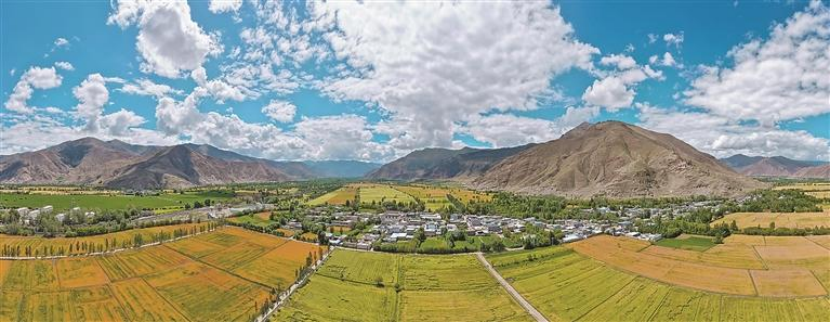
Aerial view of the seed fields in Keme Community (drone photo). [Photo/Tsering Norbu]
Sister Tsamchug stood on the ridge between the fields, gazed at the golden wheat field before her, and smiled—a smile warmed by a good harvest.
Her family was not growing ordinary wheat, but seed wheat. 25 mu of first-grade seed fields and 25 mu of second-grade seed fields, planted with "Zangqing 3000" qingke (highland barley)and "Shandong No. 7" wheat, brought in 50,000 yuan a year from selling seeds alone.
In Keme Community, Nedong District, Shannan City, there are 2,260 mu of such improved seed breeding fields. This place lies in the Yarlung Valley, where the Yarlung River and the Qonggyai River meet, depositing a vast fertile plain and giving rise to highland agriculture—less than 5 kilometers away is Sade Sotang in Zetang, Xizang's first farmland.
"If you don't select seeds when farming, you'll wear yourself out for nothing." Seeds are key to food security and the "chip" of agriculture. One seed, ten thousand mu of fertile land. Here, improved seeds have begun their journey from experimental plots to large fields, and from this one can hear the resounding footsteps of highland seed industry revitalization.
Taking root and sprouting in the Yarlung Valley
Walking along the village road in Keme Community, heavy wheat ears stretch all the way to the foot of the mountain. When the wind passes, waves of wheat roll like the strings of the earth being plucked.
In the wheat fields, "Shandong No. 7" has grown past waist height, with sturdy, upright stalks and plump grains.
The weather was hot. Several people sat on the field ridge, sickles in hand and mud on their bodies. Were it not for the white coats they wore, it would have been hard to tell their identity—technicians from the Shannan City Agricultural Technology Extension Center.
In 1965, the Shannan City Agricultural Science Institute established an experimental field. More than 20 years ago, the experimental field was set up in Keme Community, and generation after generation of scientific and technological personnel have carried on the relay of promoting improved seeds here.
Agricultural technology extension researcher Zhu Xia came to Xizang in 1993 to study. Over the more than 30 years since, she has been engaged in winter wheat breeding and technology extension, witnessing the entire process of "Shandong No. 7" going from the laboratory to the fields.
In Zhu Xia's view, doing agriculture first requires patience. Because the cycle is long, especially in highland areas, "Shandong No. 7" took nearly 20 years from configuring hybrid combinations, through multiple generations of line selection, to regional trials, production trials, and finally approval as a main promoted variety of the autonomous region.
"Writing papers on the land—without passion, you can't keep going," Zhu Xia said. No matter how good the seed is, farmers must be willing to plant it. "Shandong No. 7" took the needs of farmers and herders into account from the breeding stage. "Shandong No. 7" winter wheat is a grain-and-fodder dual-purpose type, with a plant height of 111 to 136 centimeters. It must not only ensure high yield but also serve agriculture and animal husbandry, so the straw must be long; in the extension stage, seed quality must be ensured, and every link requires attention—the highland weather is unpredictable, and if one step falls behind, a whole year's work may be wasted.
In 2013, Ma Haiwei also came. From Qinghai to Shannan, he has worked in this river valley for 13 years. "My work is here, and my family came too. You could say I've put down roots, so I'll just keep working," he said with a smile.
Guarding the laboratory, then guarding the experimental field, all the way until improved seeds are planted in fertile fields. On this fertile river valley, seeds are growing vigorously, and people's dreams are taking root and sprouting.
Growing Taller Through Intensive and Careful Cultivation
"This section is the spike-row nursery." Zhu Xia pointed to a plot that had just been harvested, casually picked up a fallen wheat ear from beside her feet, rubbed it with both hands, and plump grains rolled in her palm: "Select one ear, rub out the grains, and put them in a separate bag. When it's time to sow, open a furrow and plant one ear per row."
The plot is not large, but the work is extremely fine. Every year, selecting ears, rubbing out grains, bagging, and sowing all rely on manual labor, and nothing can be done carelessly; at harvest time, they must also be harvested separately, one bag per spike row, with no mixing—laborious and time-consuming!
From the original seed field to the first-grade seed field, purification is done once; from the first-grade seed field to the second-grade seed field, purification is done again. After gradual purification and propagation, the improved seeds are sown into large fields—thousands upon thousands of mu of fertile land.
The agricultural technology extension process is so cumbersome—how does it operate? The answer is—intensive and careful cultivation. Here, farmers are expert-type farmers; experts are farmer-type experts. Resident village cadre Tsering Norbu told the reporter: "Just take identifying off-type plants—the ordinary people are really strong now, some even better than the technicians."
Technological empowerment has also reached the fields, with technicians from the Agricultural Technology Extension Center participating throughout. "We take turns going down to the fields every day to check the growth of improved seeds, and the edge areas are where we keep an even closer watch—removing off-types and inferior plants, watching closely and pulling them out cleanly. We go to the fields to teach ordinary people hand by hand how to identify off-type plants and recognize pests and diseases," said agronomist Lobsang Drolma.
The Party branch leads the work, the cooperative drives it, and the masses follow—the improved seed breeding system of Keme Community has thus operated year after year.
Basang, secretary of the Party branch of Keme Community, has worked in the community for more than 10 years and witnessed the leaps and bounds in the development of the community's seed fields.
With improved seeds, there is no worry about sales—not only in Shannan, Qamdo, Nyingchi, and Nagqu within the region, but even in Qinghai and Gansu outside the region, there are markets. "Last year alone, Qinghai bought about 5 metric tons," Basang said, standing by the field ridge, bending down to touch the mature ears. The mature grains rolled in his palm, not a single one shriveled.
The good development momentum cannot be separated from the support of good policies: subsidies for improved seeds are 300 yuan per mu for original seed fields, 60 yuan for first-grade seed fields, and 30 yuan for second-grade seed fields, with agricultural inputs provided free of charge. In 2024 and 2025 alone, collective economic dividends in the community reached 4 million yuan and 3.6 million yuan respectively, with planting households increasing their annual income by more than 18,000 yuan on average.
"Our own original seed fields are easier to manage." Basang told the reporter that the community plans to continue expanding the area of original seed fields and has already submitted an application to further raise the standardization level of farmland. He pointed to a low-lying patch not far away: "Look at that section—it still needs proper repairing and leveling."
The water of the Yarlung River is still flowing, and the seeds are still growing. The seeds of Keme Community are walking out of the Yarlung Valley and heading to farther places. And on the field ridge, Sister Tsamchug's smile is growing ever brighter in the sunlight.
Source: Xizang Daily
Translator: Dan Zhen, Zhi Xinghua
First Review: Zhi Xinghua, Zhang Yiming
Second Review: Li Chengye, Drakpa Wangchen
Third Review: Hu Rongguo
Copyright © Xizang Daily & China Xizang News All rights reserved
Reproduction in whole or in part without permissions prohibited
Index Code: 藏 ICP 备 05000021 号
Producer: Xizang Daily International Communication Center