





Source:xzxw 2026-09-22
In Washington, D.C. in September, Li Li, who was on a visit there, carried a message book with him. Flipping through the book, you will see lines of handwritten words.
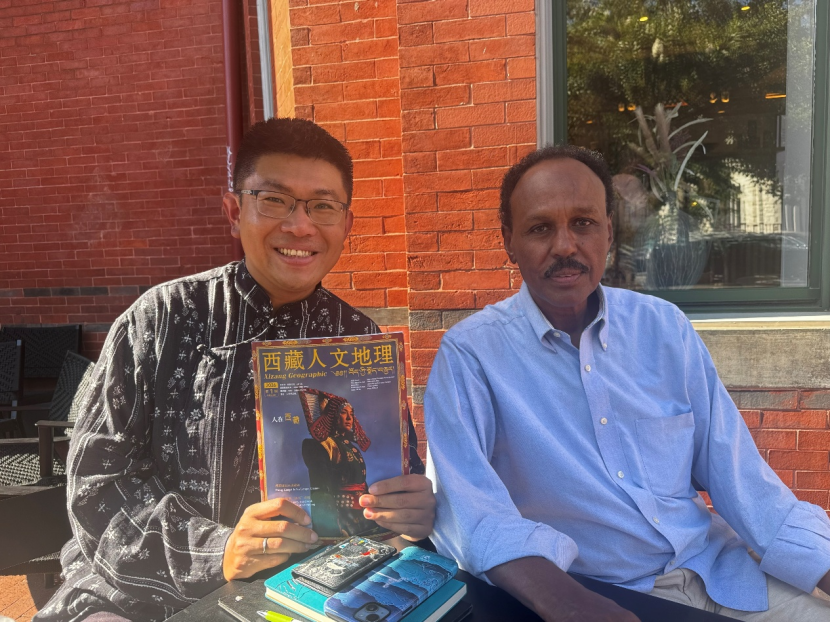
Photo shows Li Li (1st, L) taking a group photo with Abdulahi Ahmed, a librarian at the Library of Congress.
Li Li worked as an international journalist for over a decade before shifting to international communication research. He currently serves as a council member of the Chinese-African People's Friendship Association and a specially invited council member of the China Foundation for Human Rights Development. Talking to our reporter about the places he has covered over the years, he said he was one of the first Chinese journalists to enter the Fukushima nuclear leak site after the Great East Japan Earthquake. In 2015, in Pakistan-administered Kashmir, the valley blocked into a lake after the disaster left a lasting impression on him, and he later wrote the column The Angry Valley after returning.
His bond with Xizangruns even deeper. He told our reporter that over the years, he has studied Tibetan murals and Buddhism, and also sponsored Himalayan artists. Many of his American friends have fallen in love with Tibetan incense and meditation, and he has always wanted to introduce more fine Tibetan products to them. This summer, he spent almost all his time in Lhasa, and even traveled to the Sichen Lhatso.
He recalled that he originally planned to go to Nepal via the Gyirong Port in Xigaze, but the schedule was postponed to next year. Unexpectedly, this delay let him narrowly escape a sudden disaster.
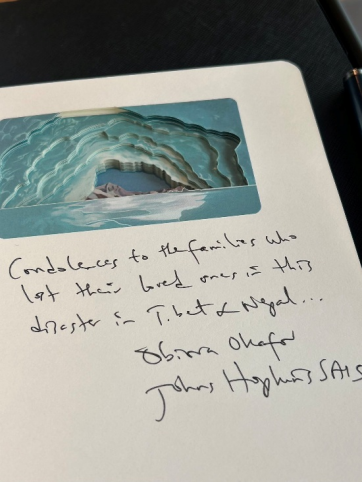
Photo shows a message from Professor Okafor, former Chair of the Advisory Committee of the United Nations Human Rights Council.
As soon as the news came, his heart ached immediately. He knew those people who made a living at Gyirong Port, the customs and immigration police guarding the border, and travelers coming from afar — they were all living ordinary, peaceful lives before the disaster.
Why did he think of using a message book? "This is a habit as a professional journalist. Words have tremendous power," he said. "In the virtual world of social media, a medium like a message book can preserve genuine emotions for a long time."
The first person to record was Gu Haihao, a Chinese student at Johns Hopkins University. He wrote: "We revere nature, we cherish life. May the deceased rest in peace."
Shortly after, Abdulahi Ahmed, librarian at the Library of Congress, and Professor Okafor of Johns Hopkins University, former Chair of the Advisory Committee of the UN Human Rights Council, also signed their names in the message book one after another, extending their condolences to the victims and their families in this disaster. From Washington D.C. to New York, more than ten friends left their messages one after another, and the book grew thicker. Next month, Li Li will go to Hawaii to hold an event, sharing the touching stories behind these pages.
Our reporter asked him, if he reserved a page for himself in the book, what would he write? He penned: "Though we are thousands of miles apart, human kindness and goodness haveno boundaries.Let's get through this tough time together, remember the deceased, and summon the courage to rebuild our homes."
Reporter: Cao Lin
Intern Reporter: Li Xinmeng
Translator: Peng Qing
Reviewer: Zhi Xinghua
Copyright © Xizang Daily & China Xizang News All rights reserved
Reproduction in whole or in part without permissions prohibited
Index Code: 藏 ICP 备 05000021 号
Producer: Xizang Daily International Communication Center