





Source:xzxw.com 2026-09-24
On the evening of September 15, in Shengpu Village, Zhayu Town, Zogang County, Qamdo City, 7 college students from needy families received remittance transfers ranging from 2,000 yuan to 5,000 yuan. The same line was written in the remarks line: "Every small step you take accumulates to cover a thousand kilometres. Wish you every success in your studies!"
The person who wrote this line is Gesang Tsering, manager of Ranba Farmers' Breeding and Planting Cooperative in Zhayu Town, Zogang County, Qamdo City, and a 2024 regional-level leading figure for farmers and herdsmen to get rich. In the past two months, he has traveled through villages including Nanni, Daba, Kani, Jideng and Shengpu with his account book, settling labor wages, visiting needy families, funding college students, and donating public welfare funds to village collectives, with a total donation of 72,000 yuan.
More often, he stays in one place, one more than 800-mu vineyard on the high slope by the Nujiang River.
The grapes are ripe
In September, the grape harvest in Ranba Village is drawing to a close. Villagers shuttle between the vine trellises to pick, sort and pack the fruits. Gesang Tsering walks over, helps cut some bunches from time to time, and shouts to the sorting shed: "Handle them gently, everyone can take a break after filling these baskets!" Baskets of grapes with standardized packaging are loaded onto trucks, ready to be sent to the winery.
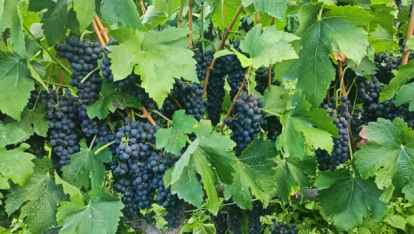
Photo shows ripe grapes in Ranba Village.
This year, the grape planting base has harvested 172,000 jin of grapes, generating an income of 860,000 yuan. But in Gesang Tsering's mind, the significance of the orchard goes far beyond these two figures.
The orchard is full of meticulous arrangements: intelligent drip irrigation pipe networks divert tributary water from the Nujiang River for precise irrigation, circular roads allow agricultural machinery to pass through the whole process, cold storage and fresh-keeping warehouses and standardized sorting sheds are all available, with full-domain intelligent monitoring. Talking about these, he is like introducing his own child: "Drip irrigation, roads, cold storage — none can be missing. If one is absent, the grapes may rot in the fields." In 2023, the cooperative was rated as a national-level model farmer one.

Photo shows honors obtained by Gesang Tsering.
The walls are covered with certificates of merit, but he rarely mentions them. What he is most proud of are the people in the orchard: "Now the young people in this village can manage the base independently." He points to the busy figures among the vine trellises in the distance, "I will train these kids well, so that they can take over when I can no longer work."
Where the vines come from
This 800-mu orchard did not fall from the sky.
Gesang Tsering grew up "eating meals from every household" in Ranba Village. He left for his relatives' home after graduating from junior high school at the age of 17, at 20, he polled 50,000 yuan to buy a second-hand truck, and transported the villagers' walnuts to Chengdu for sale. On his first trip, he paid every penny to the villagers without deduction, and covered all the freight costs himself. After that, he worked in transportation, did business, and ran a Tibetan restaurant, working outside for nearly 20 years.
In June 2015, when the call for poverty alleviation swept
across the Hengduan Mountains, the 35-year-old man returned to his hometown with all his savings to establish the cooperative. "I have understood the market outside, and I want to come back to lead the villagers to make a fortune together."
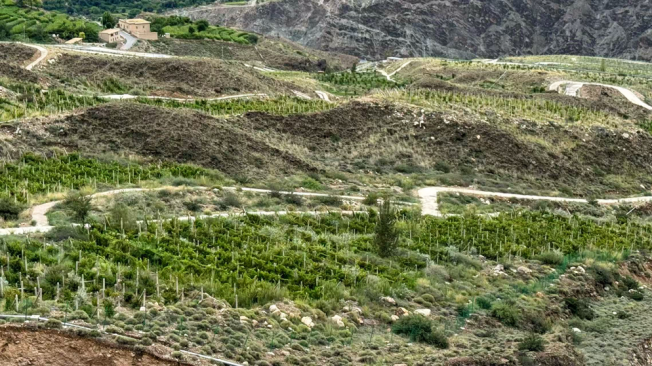
Photo shows the grape base in Ranba Village.
What to do after returning? He set his sights on the Tibetan pigs that every household raised but could not make a decent profit from. With no site available, he first built simple sheds by himself, the government helped with re-planning, and also sent him to Northwest A&F University for training.
What was more difficult than technology was to win over people. In 2016, he invited villagers to work, but few responded. Some even joked that he could not make a living outside and had to come back. He did not get annoyed. He first hired two people, paying them 8,000 yuan a year, and also gave them rice, flour and cooking oil. Dengzeng Nyima, who was a poor household at that time, came to work with a try-it-out mentality. Now he can earn 20,000 yuan a year driving a forklift. "Later, everyone saw that they could get paid by working with me, and they were all willing to come."
The turning point came in 2019. He set his sights on the grape industry again, built the grape planting base with the support of the government, introduced the Marselan variety from Ningxia, and hired technicians to settle in the village for guidance. It was very difficult at the beginning to get the villagers to follow the technicians' requirements. The technicians required bud picking and shoot thinning, but the villagers were reluctant to prune the branches. He talked a lot, set a demonstration in his own field first, and persisted through all difficulties.
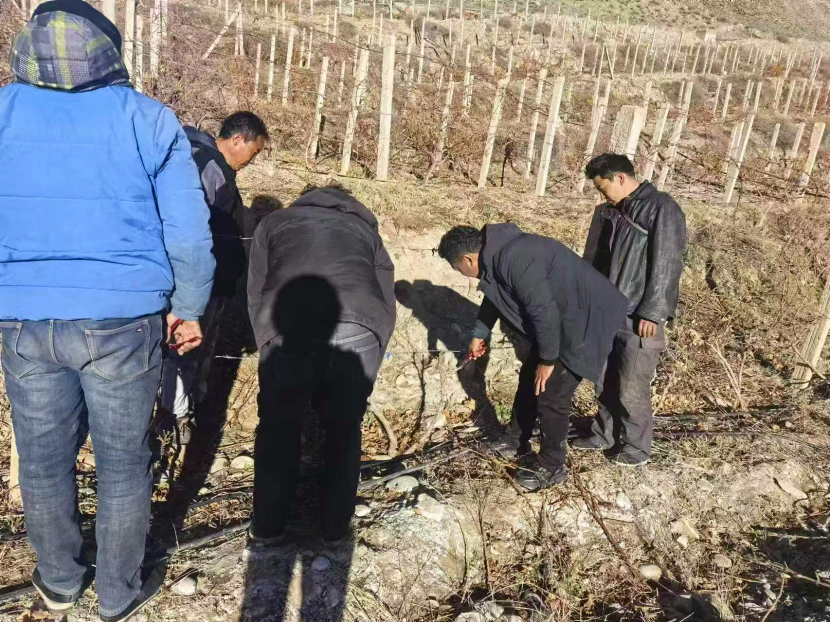
Photo shows the planting technology training at the grape base.
He taught the villagers hand in hand. Gyeltsen, who had no family income at that time and whose elderly family member was waiting for surgery, has now become a technical backbone of the cooperative, capable of independently leading teams to manage the vineyard. A group of local technical backbones, rural industry experts and rural prosperity experts have grown up at the base.
Who enjoys the sweetness
In 2024, the grape base achieved a high yield of more than 160,000 jin.
Dividends have also risen year by year. At the 2024 dividend distribution meeting, Jicuo Dawa, a villager, held the 6,500-yuan dividend and smiled: "The dividends are getting higher year by year, and everyone is more motivated!"
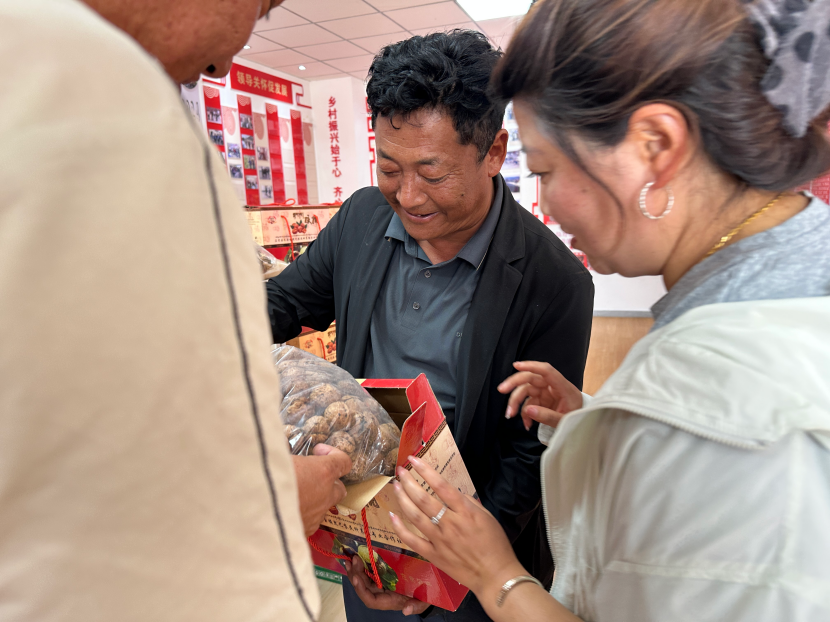
Photo shows Gesang Tsering (M) introducing various products of the cooperative.
His other account book is recorded over a longer period of time. Many people do not know that he started funding college students back in 2017 . "If kids learn better at school, it will be easier for them to find jobs in the future," he said.
In 2015, when a mudslide hit Ranba Village, he paid out of his own pocket to clear farmland, repair canals and pave roads; he has long adhered to visiting needy families every Tibetan New Year and funding poor college students at 5,000 yuan per person per year. He has persisted in doing such good deeds for many years. As of 2026, his total donations have exceeded 2.72 million yuan.
Photo shows the dividend distribution ceremony of the cooperative in 2025.
From a child who grew up relying on the kindness of the whole village to a regional leading figure for farmers and herdsmen to get rich, Gesang Tsering has proved with 10 years of time. One person who dares to pioneer can revitalize an entire industry, one leader can lift a whole region's villagers to prosperity. Vines twining together eventually form a vast vineyard — this is exactly the most vivid scene on the road to rural revitalization.
Reporters: Zhou Tingting, Wen Kai
Translator: Peng Qing, Zhi Xinghua
Reviewer: Drakpa Wangchen, Hu Rongguo
Copyright © Xizang Daily & China Xizang News All rights reserved
Reproduction in whole or in part without permissions prohibited
Index Code: 藏 ICP 备 05000021 号
Producer: Xizang Daily International Communication Center