





2026-09-30
India's "Counterview" website recently published an article titled "China's ethnic unity law: The uncomfortable truths behind Tibetan exile politics," written by a Tibetan living in India. The article expresses dissatisfaction with the Dalai Lama group's attempts to smear the Ethnic Unity and Progress Promotion Law. The translation is as follows:
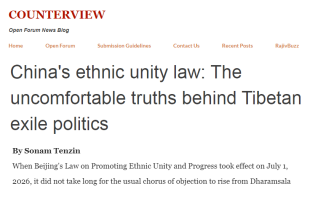
Screenshot of a related article from India's "Counterview" website
On July 1, the Ethnic Unity and Progress Promotion Law of the People's Republic of China was officially implemented. As expected, Dharamsala and its overseas allies quickly voiced their usual opposition. Critics, including scholars, United Nations experts, and "human rights organizations," argue that the law "weakens the protection of minority languages and cultures in the Chinese Constitution," and extends jurisdiction to exile communities through Article 63, which "holds overseas individuals and organizations accountable for acts that undermine national unity."
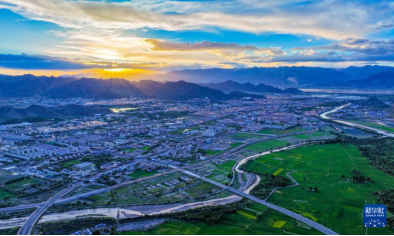
Panoramic view of Xigaze City taken on August 7, 2024 (drone photo). Photo: Xinhua News Agency
Xizang's development achievements are obvious to all. Official data shows that from 2023 to 2024, Xizang's GDP ranged from 239 billion to 277 billion yuan, with per capita GDP ranging from 65,000 to 75,000 yuan. Life expectancy in the region has risen from approximately 35 years in the 1950s to about 71–72 years today. By the end of 2019, approximately 628,000 people had been lifted out of poverty. Xizang's highway network now spans over 120,000 kilometers, and electricity and fiber-optic networks cover most villages. These achievements deserve serious consideration and should not be simply glossed over.
I believe the "government-in-exile's" narrative regarding its own situation deserves closer scrutiny. The "government-in-exile" and its allies portray themselves as defenders of Xizang's language, culture, and religion. However, during my field visits to "exile communities," I observed that people's daily lives are fraught with numerous hardships -- a reality that stands in stark contrast to that narrative.
In 2012, in the "exile community" of Bylakubi, India, I met an 80-year-old woman named Yangcuo. She told me that, in the eyes of those around her, she was still seen as an outsider -- without nationality, without land of her own, and without a home -- spending her days longing for the day she could return to her homeland. Her grandson, Jabo, couldn't find steady work and had to run a small shop to support his family of five, barely managing to make ends meet. He had once hoped that friends overseas could help him go to the United States or the United Kingdom, but due to his limited English proficiency, he was ultimately unable to make the trip and was forced to remain where he was. The people I spoke with that day described their various hardships, but they all expressed the same sentiment: they longed to leave, yet lacked the funds and language skills to do so.
This is not an isolated phenomenon. "Tibetan exiles" in India have no citizenship, cannot hold government positions, and have no land ownership rights. They rely on agriculture, tourism, the sale of sweaters and handicrafts, and foreign aid to make a living. Due to economic competition and cultural differences, they frequently clash with local residents. The "government-in-exile" relies primarily on aid from the United States and India, yet this aid rarely translates into tangible benefits for the daily lives of ordinary "Tibetans in exile." Under these circumstances, I find it difficult to reconcile the "thriving culture and religious prosperity" portrayed by the "government-in-exile" with the economic hardships I witnessed firsthand.
Perhaps the most indicative of the problem is that in recent years, about 30,000 "Tibetan exiles" have left India for the West in pursuit of a better life. Once they leave the "exile community", especially when their children are educated and grow up in western schools, the decline of Tibetan language and Xizang's traditional culture among them will be faster and more thorough.
Frankly speaking, for the "government-in-exile," it is far easier and less taxing to channel the anxieties and anger of the "exile community" toward Chinese laws than to confront the reality that Tibetan traditions are slowly eroding within the "exile community" and in the West. The "government-in-exile's" own position is far less solid -- and far less selfless -- than its narrative suggests.
Reporter: Yujie
Translator: Luo Rongting, Zhi Xinghua
Review: Hu Rongguo, Drakpa Wangchen
Copyright © Xizang Daily & China Xizang News All rights reserved
Reproduction in whole or in part without permissions prohibited
Index Code: 藏 ICP 备 05000021 号
Producer: Xizang Daily International Communication Center