





Source:xzxw.com 2026-11-06
Development is the fundamental support for Xizang to build a "National Demonstration Zone for Border Consolidation, Border Revitalization, and People's Prosperity." Gar County in Ngari Prefecture has offered its own answer with small industries rooted in the local land.
Located on the western Xizang Plateau, Gar County is an important gateway for guarding the southwestern border of the motherland. Following a development logic of being small but refined, distinctive but excellent at the county economy level, Gar County does not seek scale but characteristics, values ecology and long-term development, and precisely directs limited resources to industries suitable for local conditions and collective operations that drive local people's income growth. In a harsh environment, it has blazed a path of "prospering borders and enriching the people through industry."
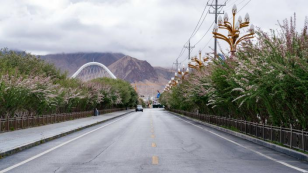
Photo: A street scene in Gar County, Ngari Prefecture, with red willows lining the road and branches swaying. Photo by reporter Ngodrup Tsering.
In the sunny greenhouse of the seedling industry base in Luma Village, Gar County, warmth fills the air. Villager Butri presses a switch, and the intelligent sprinkler system starts. Fine mist falls evenly, and in less than a minute, 4,320 red willow seedlings are thoroughly watered.
"Watering is so convenient now — one switch is all it takes," Butri said, crouching down to check the seedlings' growth. "These seedlings were planted at the end of 2025 and in the first half of 2026. Their roots have taken hold well, and the branches are growing vigorously."
Gar County has an average altitude of 4,500 meters. The county Party committee and government adhere to the principle of "planting greenery where greenery is lacking, "turning natural shortcomings into industrial advantages, cultivating locally adapted seedlings according to local conditions, making the seedling industry a growth point of the county economy, and embarking on a path of "beautifying the border with greenery."
Highland seedlings have a low survival rate when planted directly in the ground, so the base adopts a method of "rooting in greenhouses and hardening seedlings in the open air." Relying on the "one village, one product" project, all 127 households in the village have been included in the cooperative, with every household holding shares. During construction, the project employed local farmers and herdsmen in large numbers, generating 800,000 yuan in wages and nearly 5.9 million yuan in income for villagers from machinery leasing.
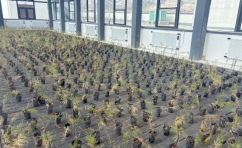
Photo: Seedlings being propagated in the sunny greenhouse of the seedling industry base in Luma Village, Gar County. Photo by reporter Ngodrup Tsering.
Butri learns techniques while working and earns more than 7,000 yuan a month. "Once I have mastered the techniques, this will be our village's cash cow in the future."
What was once barren Gobi desert is now gradually gaining trees. Sales of seedlings outside the county have broadened channels for increasing fiscal revenue and people's income. Local people earn wages from work, rent from land transfers, and cash from seedling sales. Gar County vigorously develops the seedling economy and has turned the green industry into a pillar of prosperity for the county and its people. More importantly, the stretching greenery has curbed windblown sand, improved the soil, and built an ecological barrier for the border. A small seedling takes root at the forefront of the country's territory, with its branches reaching toward the front line of border prosperity. Gar County has used the seedling industry as a small entry point to leverage the larger picture of prospering borders and enriching the people.
"Greenery" has always been a major direction for Gar County's efforts, and growing vegetables is also a top priority. In the early days, high-altitude areas of Gar County had a frost-free period of less than 90 days and a day-night temperature difference of more than 25°C. Traditional open-air cultivation was difficult to scale up, and vegetables long depended on transportation from other places. The vegetable supply issue was not only a pain point in people's livelihood but also related to whether border residents could settle down and guard the border with peace of mind. Gar County took protected agriculture as a starting point for "prospering the border through industry"and built and put into operation an ecological agriculture industrial park in 2018.
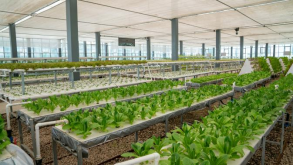
Photo: Soilless cultivation vegetables growing well in the Gar County Ecological Industrial Park. Photo by reporter Ngodrup Tsering.
To overcome planting difficulties such as high altitude, low temperatures, strong ultraviolet radiation, and a short frost-free period, Gar County joined forces with agricultural experts from aid-Xizang teams and the Xizang Academy of Agricultural and Animal Husbandry Sciences to form a highland planting technology task force. They iteratively upgraded a complete set of technologies, including five-layer film insulated greenhouses, soilless cultivation, and soil improvement, and established a local seedling breeding base, solving the core problems of "not being able to grow" and "not growing well."
At present, the park has cumulatively planted more than 40 varieties in four major categories: leafy vegetables, solanaceous fruits, melons and fruits, and specialty varieties. More importantly, the park gives priority to ensuring local vegetable supply and also teaches soilless cultivation techniques to border defense troops, so that border-guarding officers and soldiers can eat fresh vegetables.
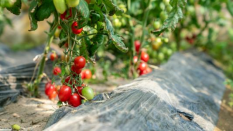
Photo: Clusters of cherry tomatoes glisten in greenhouses at the Gar County Ecological Industrial Park, displaying modern agricultural charm. Photo by reporter Ngodrup Tsering.
The "vegetable basket" is linked to the "money bag." As a supporting industry for Kangle New Residence, the largest relocation site for poverty alleviation in Ngari Prefecture, the park has built a model of "government backstop, enterprise operation, cooperative linkage, and participation by farmers and herdsmen."
One tree greens the border, one basket of vegetables warms the border, and one cooperative gathers people and keeps them there. Gar County uses the ecological industrial park to ensure supply, the seedling industrial park to build green capacity, and the village collective economy to rally people. It has built a high-quality county economic development pattern of "beautifying the border with greenery, prospering the border with industry, and consolidating the border with prosperity." The warm current of rural revitalization nourishes the border areas, and the picture of prosperous borders and enriched people unfolds across the western Xizang Plateau.
Reporter: Ngodrup Tsering, Hu Rongguo, Zhou Hui, Zhang Qi, Geng Ruixian, Zhao Wenhui, Kang Zhuo
Translator: Luo Rongting
First Review: Pan Lu, Liu Fang
Second Review: Li Chengye
Third Review: Hu Rongguo
Copyright © Xizang Daily & China Xizang News All rights reserved
Reproduction in whole or in part without permissions prohibited
Index Code: 藏 ICP 备 05000021 号
Producer: Xizang Daily International Communication Center