





Source:xzxw.com 2026-11-06
In the early morning, in a Tibetan incense workshop in Puqu Town, Bayi District, Linzhi City, the fragrance of cypress wood and herbs slowly filled the air. Samdrup squatted in front of the workbench, his hands covered in incense mud, straightening and stacking a bundle of newly shaped Tibetan incense.
Samdrup is a representative inheritor of Linzhi Tibetan incense as intangible cultural heritage, and the founder of the Weitong Limin Tibetan Incense Processing and Production Farmers and Herders Professional Cooperative in Jiemai Village, Puqu Town, Bayi District, Linzhi City, and of Linzhi Bayi District Damola Industry and Trade Co., Ltd. Ten years ago, he started from a simple workshop, guarding the ancestral ancient incense formulas and feeling his way forward bit by bit. Ten years later, he has brought Tibetan incense to a monthly transaction volume of 4.6 million yuan and annual revenue exceeding 30 million yuan, while also helping more than 20 fellow villagers earn a stable income at their doorstep.
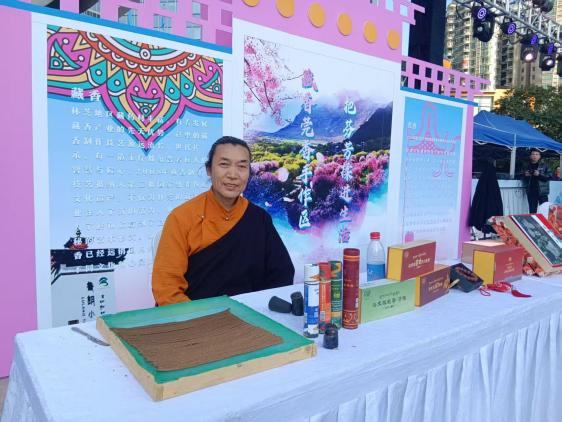
Photo shows Samdrup at an exhibition and sales fair.
Old formula, new flavor
Samdrup grew up surrounded by the scent of Tibetan incense. The incense formulas and handmade techniques passed down through his family were, in his heart, not just a craft but an inseparable cultural attachment.
In those years, as he saw traditional Tibetan incense techniques lacking in inheritance, the local industry remaining small in scale, and quality local products "hidden deep in the mountains and unknown to the world," Samdrup planted the seed of a dream: to inherit the intangible cultural heritage, strengthen the industry, and lead his fellow villagers forward.
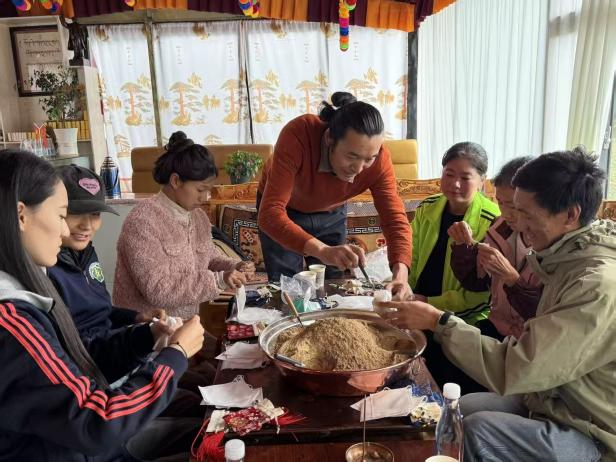
Photo shows Samdrup teaching Tibetan incense-making techniques.
In 2016, he made up his mind to start a business and established the Weitong Limin Tibetan Incense Processing and Production Farmers and Herders Professional Cooperative in Jiemai Village, Puqu Town, Bayi District, Linzhi City. But reality quickly brought setbacks: the workshop was old, the product line was limited, and there was no brand and no sales channel. The hardest part was not even these— public awareness of traditional Tibetan incense was simply too limited, and the market could not be opened.
But Samdrup did not retreat. While carefully studying the ancient incense formulas and repeatedly refining the process, adhering to purely handmade production, purely herbal ingredients, and no additives, he also thought about how to improve the old incense, whose heavy scent young people were not quite used to. After much thought, he did something many people saw as "foolish": he took his team to 53 cities across the country, spending three full years talking face to face with more than 20,000 consumers to find out what scents people liked, which settings were suitable for burning incense, and what kind of packaging appealed to consumers. He noted everything down and came back to adjust the ancient formulas bit by bit.
As a result, the foundation of the ancient method remained unchanged, but the scents became lighter and more elegant, the forms more delicate, and the packaging closer to modern aesthetics.
The incense was made, but Samdrup found that however good the product was, it was useless if it stayed deep in the mountains and no one knew about it.
A workshop deep in the mountains goes online
In 2020, Linzhi Bayi District Damola Industry and Trade Co., Ltd. was officially established, and Samdrup's Tibetan incense business formally crossed the threshold from a small workshop to an enterprise.
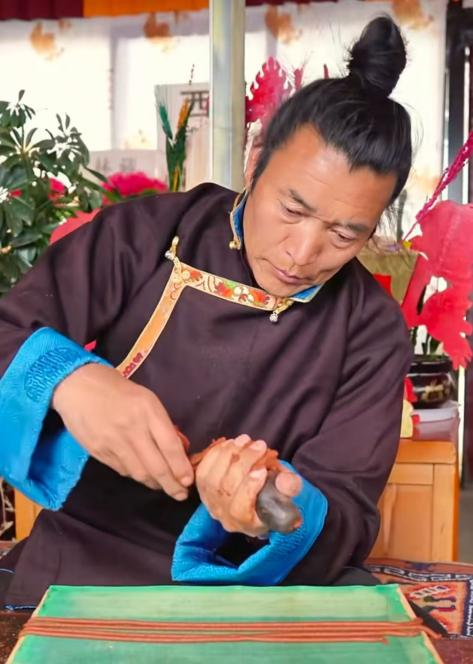
Photo shows Samdrup sorting Tibetan incense.
At that time, many intangible cultural heritage products were still hesitant about the new path of e-commerce. Samdrup's approach was very simple: he set up a mobile phone, started a live stream, and pointed the camera at his hands kneading, drying, and collecting incense. There was no script, no lines — just a pair of hands covered in incense mud working busily in front of the camera. As netizens watched, they began to ask: "How do I buy this incense?" "Can you deliver it to Shanghai?"
That was how orders came. Monthly transaction volume rose from more than 800,000 yuan at the beginning to 4.6 million yuan. In 2024, the enterprise's annual revenue exceeded 20 million yuan, and in 2025 it reached 30 million yuan. Samdrup has set a goal for himself: "I want to make a name for Linzhi Tibetan incense in China's incense community."
Once on solid footing, he reaches out to help
"As the business grows, I must not forget my hometown or my fellow villagers." This is something Samdrup often says. It is not a pretty slogan, but something he has done one concrete thing after another.
Samdrup's company currently has 21 employees, all local farmers and herders or returning college graduates. Over the years, employees' wages have risen year after year. Having a stable income in their hometown while being able to care for their families makes everyone feel secure.
Samdrup has not forgotten those who need more help. Since 2017, he has insisted on paying dividends to disadvantaged households, and later expanded the scope of support to more low-income families. Every year he also allocates special funds for skills training for people with disabilities and holiday visits and assistance. When disasters occur, he is also among the first to reach out, donating money and goods without hesitation.
In addition, Samdrup has turned the workshop into a classroom, actively building practical platforms for young people and regularly providing public-interest training to local college students and young entrepreneurs, teaching them hand by hand how to identify incense, make incense, and understand the market. "If someone is willing to learn, I am willing to teach," he says.
These efforts have also been recognized. In 2018, Samdrup was named one of Linzhi City's "Top 100 Honorable Households for Poverty Alleviation and Prosperity." Later he received multiple honors, including Advanced Individual in Innovation and Employment of the Xizang Autonomous Region, Advanced Individual in Employment and Entrepreneurship of the Xizang Autonomous Region, the Linzhi City May 1 Labor Medal, and Advanced Individual in Poverty Alleviation at the municipal and district levels. But he still "immerses himself" in the workshop every day, with incense mud never leaving his hands.
From clinging to the ancestral incense formulas and not daring to change them, to setting up a phone and selling Tibetan incense across the country, to pulling fellow villagers along to prosperity together — Samdrup's ten years have actually been short, but a stick of Tibetan incense has burned out a path of his own and warmed the lives of his fellow villagers.
Translator: Luo Rongting
First Review: Pan Lu, Liu Fang
Second Review: Li Chengye
Third Review: Hu Rongguo
Copyright © Xizang Daily & China Xizang News All rights reserved
Reproduction in whole or in part without permissions prohibited
Index Code: 藏 ICP 备 05000021 号
Producer: Xizang Daily International Communication Center